Only 1 in 8 couples struggle to conceive, yet for those trying to get pregnant, understanding the specific factors that influence their chances can feel like navigating a maze. A pregnancy odds calculator helps individuals and couples estimate their likelihood of conceiving by analyzing key fertility data, providing a personalized insight into their unique reproductive window in 2026.
Key Takeaways
- A pregnancy odds calculator estimates your chances of conception based on personal fertility factors.
- Key inputs include age, cycle length, timing of intercourse, and sometimes lifestyle data.
- The calculator highlights your most fertile window, typically around ovulation.
- Accuracy is influenced by the quality and completeness of the data you provide.
- It serves as an educational tool, not a diagnostic one; always consult a healthcare provider for medical advice.
- Understanding your odds can reduce anxiety and guide family planning decisions.
- Regular menstrual cycles and timed intercourse significantly improve success rates.
- Fertility declines with age, especially for women, a factor heavily weighted in these calculators.
- Lifestyle choices, while not always direct inputs, play a crucial role in overall fertility.
What is a Pregnancy Odds Calculator and How Does It Work?
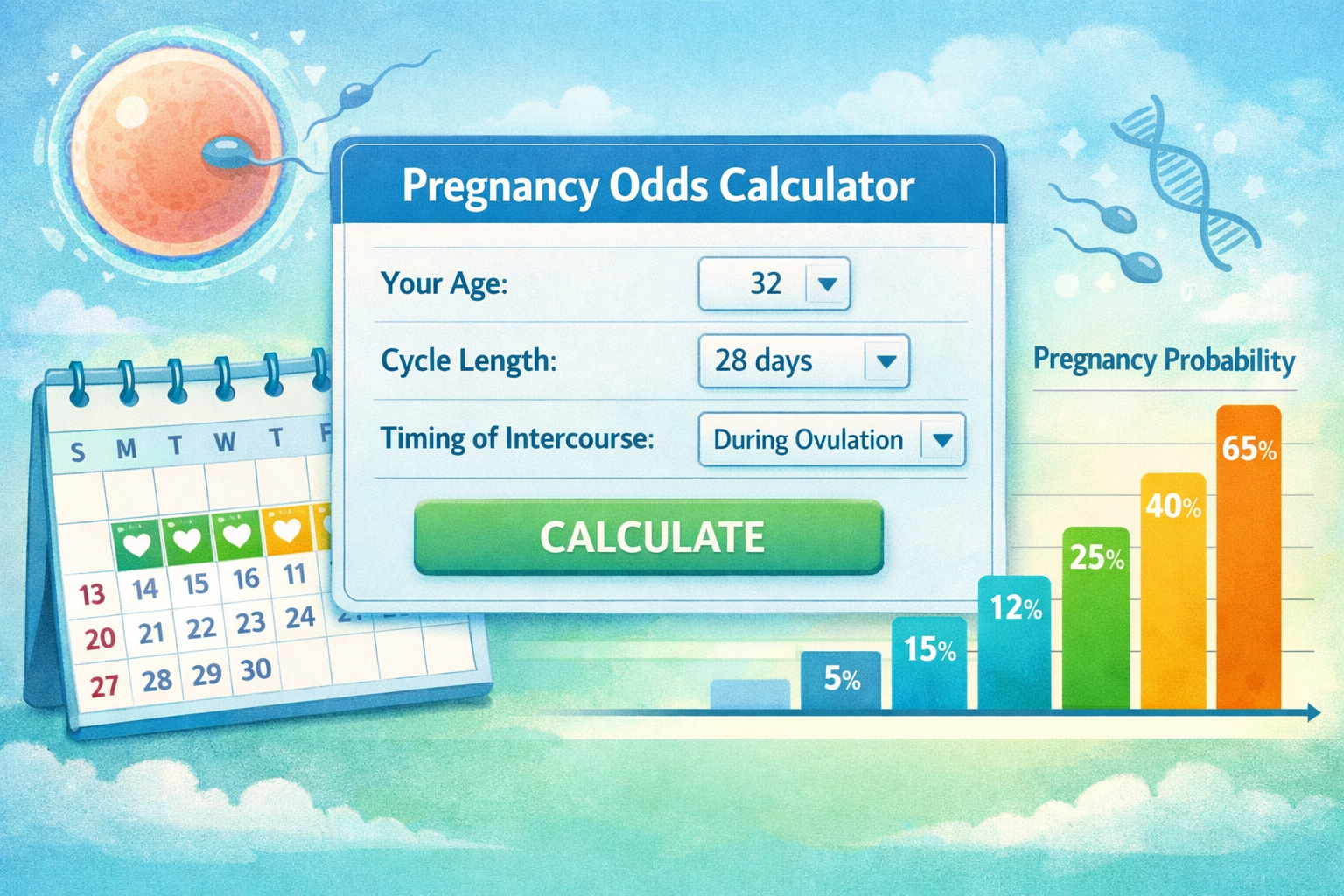
A pregnancy odds calculator is an online tool designed to estimate your probability of conceiving based on a series of personal biological and behavioral inputs. This calculator works by applying established fertility science and statistical models to the information you provide, such as your age, average menstrual cycle length, the date of your last period, and critically, the timing of sexual intercourse relative to your ovulation.
These calculators leverage data points to pinpoint your likely fertile window—the few days each month when conception is possible. By understanding when you ovulate, which is when an egg is released from the ovary, the calculator can determine the optimal days for intercourse to maximize your chances. Sperm can live for up to five days inside a woman's body, while an egg is viable for only 12 to 24 hours after ovulation. Therefore, having intercourse in the days leading up to and on the day of ovulation is key. For a deeper dive, explore our comprehensive Ovulation Calculator.
Consider a 30-year-old woman with a regular 28-day cycle, whose last period began on April 1st, 2026. If she accurately inputs this into a pregnancy odds calculator, the tool will estimate her ovulation around April 14th and identify her fertile window as approximately April 9th-15th. If she also inputs that she had unprotected intercourse on April 12th, the calculator will then provide a percentage likelihood of pregnancy for that cycle, taking into account the proximity of intercourse to ovulation. The more precise the inputs, especially regarding cycle regularity and intercourse timing, the more refined the odds will be. However, it’s important to remember that these are statistical probabilities, not guarantees.
What Factors Influence Your Pregnancy Odds?
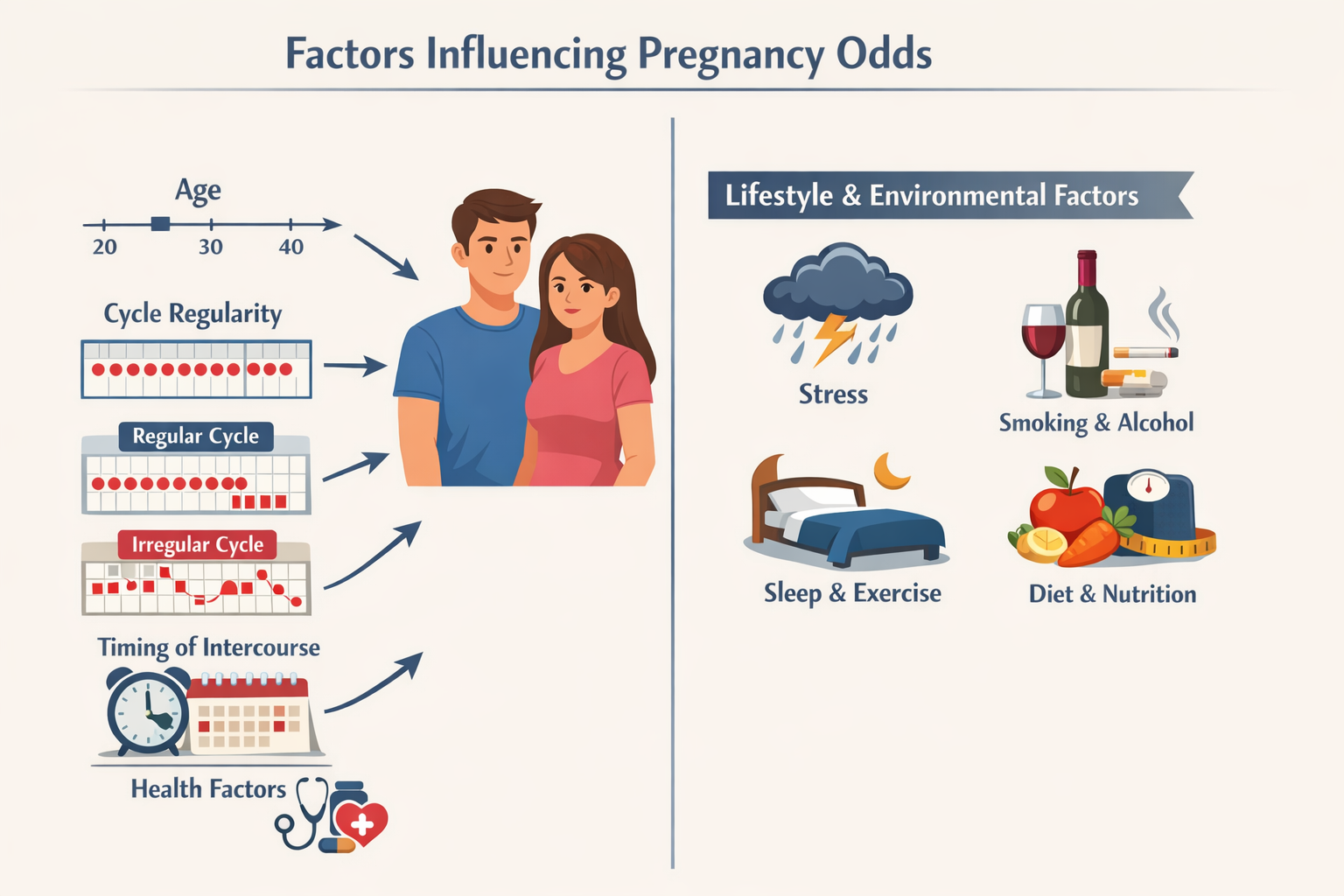
Your pregnancy odds are influenced by a complex interplay of several factors, including maternal age, menstrual cycle regularity, timing of intercourse, and overall health and lifestyle. Understanding these elements is crucial for anyone trying to conceive, as they are the primary data points a pregnancy odds calculator evaluates.
Let's break down the key influencers:
- Age: This is arguably the most significant factor, especially for women.
- Women: Female fertility generally peaks in the early to mid-20s and begins to decline in the early 30s, with a more rapid decline after age 35. By age 40, the chance of conceiving each month is significantly lower than in the 20s. For example, a 30-year-old woman has about a 20% chance of getting pregnant each cycle, while a 40-year-old woman has approximately a 5% chance per cycle (American Society for Reproductive Medicine, 2012). For more specific information, check our articles on chances of getting pregnant at 30, at 35, and at 40.
- Men: While male fertility doesn't decline as sharply as female fertility, sperm quality and quantity can decrease with age, typically after 40-50, potentially affecting conception odds.
- Menstrual Cycle Regularity and Length: A regular menstrual cycle, typically 21 to 35 days long, indicates consistent ovulation, which is essential for conception. Irregular cycles can make it harder to predict ovulation and thus reduce the chances of accurately timing intercourse.
- Example: A woman with a highly irregular cycle might find a pregnancy odds calculator less precise because the fertile window is harder to pinpoint. Tracking cycle length is a fundamental step.
- Timing of Intercourse: The highest chance of pregnancy occurs when intercourse happens within the "fertile window," specifically on the day of ovulation and the five days leading up to it. Sperm can live for several days, but an egg is only viable for a short period after release.
- Tip: Using tools like an Ovulation Calculator or tracking basal body temperature (BBT) can help identify this window more accurately.
- Overall Health and Lifestyle:
- Weight: Being significantly underweight or overweight can impact hormone balance and ovulation.
- Smoking and Alcohol: Both smoking and excessive alcohol consumption are detrimental to fertility in both men and women.
- Stress: High stress levels can affect hormone regulation and menstrual cycles.
- Underlying Medical Conditions: Conditions such as Polycystic Ovary Syndrome (PCOS), endometriosis, thyroid disorders, or sexually transmitted infections (STIs) can impact fertility.
- Medications: Certain medications can interfere with ovulation or sperm production.
- Duration of Trying: For couples under 35, generally, if conception hasn't occurred after 12 months of regular, unprotected intercourse, it's recommended to consult a fertility specialist. For those over 35, this timeline shortens to 6 months.
Understanding these factors allows for more informed use of a pregnancy odds calculator and helps individuals make proactive choices regarding their reproductive health. For instance, if you have irregular cycles, a calculator might suggest that tracking your fertile window with more advanced methods (like ovulation predictor kits) is even more critical.
How Accurate Are Pregnancy Odds Calculators in 2026?
Pregnancy odds calculators in 2026 are valuable educational tools, but their accuracy is a function of the quality of your inputs and the complexity of the underlying algorithm; they are not diagnostic and cannot account for all individual biological variables. While they provide statistical probabilities, they cannot guarantee conception or pinpoint the exact moment of ovulation with 100% certainty.
Here's what determines their accuracy:
- User Input Accuracy: The primary driver of a calculator's accuracy is the data you provide.
- Precise Cycle Information: If you accurately track your cycle length and the start date of your last menstrual period (LMP), the calculator can better estimate your ovulation.
- Consistent Data: Providing consistent data over several cycles allows the calculator to establish a more reliable pattern.
- Algorithm Sophistication: More advanced calculators incorporate a wider range of factors beyond just cycle length and LMP, such as:
- Age: As discussed, age is a critical determinant of female fertility.
- Luteal Phase Length: The time between ovulation and your next period, which is typically stable (12-16 days).
- Intercourse Timing: The calculator weights odds based on when intercourse occurred relative to the estimated fertile window.
- Optional Health Metrics: Some calculators may allow input for BMI, smoking habits, or existing medical conditions, though these are less common in simple online tools.
- Limitations to Accuracy:
- Individual Variability: Each person's body is unique. Hormonal fluctuations, stress, illness, and travel can all shift ovulation timing, even in individuals with typically regular cycles. A calculator provides an average, not a personalized real-time biological reading.
- Undiagnosed Fertility Issues: Calculators cannot identify underlying fertility problems such as blocked fallopian tubes, male factor infertility, or conditions like PCOS or endometriosis. For such concerns, a healthcare professional's assessment is essential.
- Single-Cycle Focus: Most online pregnancy odds calculators assess probabilities on a per-cycle basis. They don't account for cumulative chances over several months or years.
- External Factors: Lifestyle factors, stress, diet, and sperm quality are hard for a basic online tool to quantify.
In practice, a pregnancy odds calculator provides a helpful baseline understanding of your fertile window and general probabilities. For instance, if a calculator indicates a 15-25% chance of pregnancy in a given cycle for a woman in her early 30s, this aligns with general population statistics. However, if you consistently use a calculator and time intercourse accordingly for several months without success, it's a strong indicator to consult a doctor. While tools like the Pregnancy Chance Calculator can empower you with information, they should always be complemented by professional medical advice, especially if you have concerns about accuracy or your fertility journey.
Who Should Use a Pregnancy Odds Calculator?
A pregnancy odds calculator is most beneficial for individuals and couples who are actively trying to conceive and wish to understand their fertile window and general conception probabilities. It serves as an informative tool for proactive family planning, particularly for those who are just starting their conception journey.
- Individuals with Regular Menstrual Cycles: If your cycles are consistently 21-35 days long, a calculator can quite accurately predict your ovulation and fertile window. This allows for precise timing of intercourse to maximize chances.
- Couples Just Beginning to Try: It provides a great starting point for understanding the "when" of conception, reducing some of the guesswork and anxiety associated with early attempts.
- Those Seeking to Optimize Timing: For those who want to ensure they are having intercourse during their peak fertile days, the calculator can highlight these crucial times. Our Fertile Window Calculator offers another specialized tool for this.
- Individuals Who Want to Learn About Their Cycle: It can be an educational resource, helping users understand the relationship between their cycle length, ovulation, and the potential for pregnancy.
- As a Complement to Other Tracking Methods: When used alongside methods like basal body temperature (BBT) tracking or ovulation predictor kits (OPKs), a pregnancy odds calculator can help cross-reference and confirm findings.
However, it's generally less suitable as a primary tool for:
- Individuals with Highly Irregular Cycles: For these individuals, ovulation prediction is much more challenging, and a calculator's estimates may be unreliable. Medical consultation is often recommended in such cases.
- Those Suspecting Fertility Issues: If you have been trying to conceive for a year (or six months if over 35) without success, or have known medical conditions affecting fertility, a calculator is not a substitute for professional medical evaluation.
- As a Contraception Method: A pregnancy odds calculator is not a reliable method for preventing pregnancy. Its purpose is to maximize the chances of conception, not to predict its absence.
Ultimately, the pregnancy odds calculator is best utilized by those who are healthy, have regular cycles, and are looking for a straightforward way to understand and improve their chances of natural conception within a reasonable timeframe.
Step-by-Step: Using a Pregnancy Odds Calculator Effectively
To effectively use a pregnancy odds calculator, you need to gather accurate personal data and understand what each input means for your results. Following these steps will help you get the most reliable estimate of your conception chances in 2026.
1. Gather Your Essential Information
Before you start, make sure you have the following details handy:
- Your Age: This is a crucial factor, as female fertility significantly declines with age.
- First Day of Your Last Menstrual Period (LMP): This marks the beginning of your current cycle.
- Average Menstrual Cycle Length: This is the number of days from the first day of one period to the first day of your next period. Tracking this for a few months (e.g., using a period tracker app or a simple calendar) makes this input more accurate.
- Tip: If your cycle length varies, use the average of your last 3-6 cycles. Our How to Calculate Cycle Length guide can assist.
- Luteal Phase Length (Optional, but enhances accuracy): The time from ovulation until the start of your next period. This is usually a consistent 12-16 days. If you don't know it, most calculators will use a default of 14 days.
- Date(s) of Unprotected Intercourse: Inputting the specific dates you had unprotected sex allows the calculator to assess if intercourse occurred within your fertile window.
2. Input Data into the Calculator
Navigate to a reliable pregnancy odds calculator and accurately enter the requested information into the respective fields. Double-check your entries to avoid errors.
3. Review and Interpret Your Results
The calculator will typically provide:
- Your Estimated Ovulation Date: This is the most likely day you released an egg.
- Your Fertile Window: This is usually the 5 days leading up to ovulation, plus the day of ovulation itself. This six-day window is when you are most likely to conceive.
- A Percentage Chance of Pregnancy: This is the calculator's estimate of your probability of conceiving in that specific cycle, given your inputs.
4. Understand What the Odds Mean
- Statistical Probability: Remember that the percentage is a statistical probability, not a personal guarantee. A 20% chance means that, statistically, 20 out of 100 women with your specific inputs would conceive in that cycle. It doesn't mean you personally have a 1 in 5 chance that will definitely apply to you this month.
- Context is Key: Consider the results in the context of typical fertility rates. For healthy couples under 30, the chance of conception per cycle is around 20-25%. If your results align, it suggests you're within a normal range.
5. Take Action Based on Insights
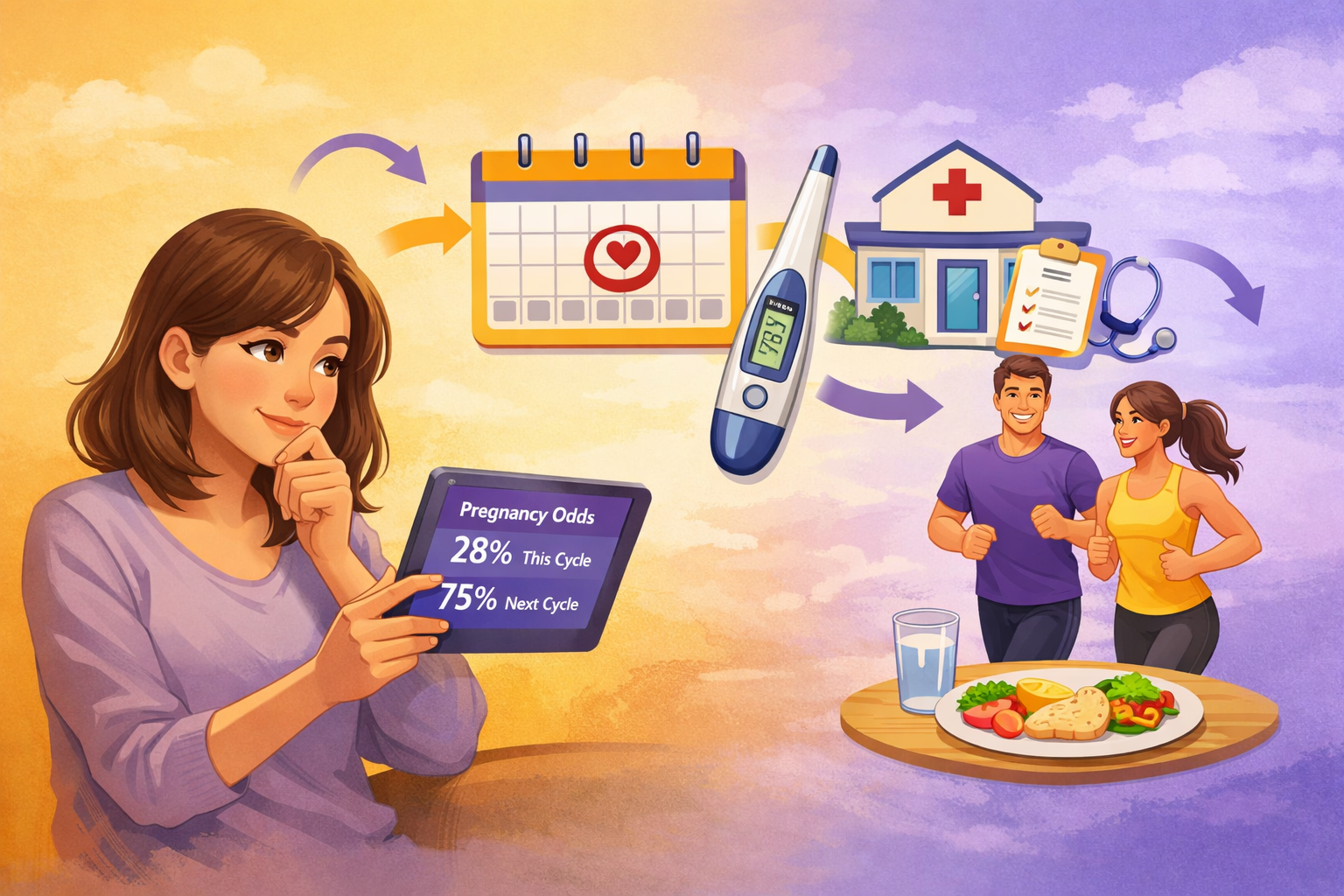
- Adjust Intercourse Timing: If the calculator shows you missed your fertile window, you can adjust your timing for the next cycle.
- Continue Tracking: Consistent tracking helps refine future predictions.
- Consider Other Tools: If you have irregular cycles or want to confirm ovulation, consider using ovulation predictor kits (OPKs) or basal body temperature (BBT) charting in conjunction with the calculator.
- Consult a Professional: If after several cycles of accurately timed intercourse, you are still not conceiving, or if your results are surprisingly low without obvious reasons, it may be time to consult a doctor or fertility specialist.
By following these steps, you can harness the power of a pregnancy odds calculator to better understand your body and optimize your journey toward conception.
What Are the Benefits and Limitations of Using a Pregnancy Odds Calculator?
Using a pregnancy odds calculator offers distinct advantages for individuals trying to conceive, but it also comes with important limitations that users should be aware of. Understanding both sides ensures realistic expectations and appropriate usage.
Benefits 👍
- Empowerment Through Knowledge: Provides a sense of control and understanding of one's fertility cycle, demystifying the conception process.
- Identifies Fertile Window: Clearly highlights the most opportune days for intercourse, which is crucial for maximizing conception chances. This is often the primary reason people seek out a Fertile Window Calculator.
- Reduces Guesswork: For couples newly trying to conceive, it offers a structured approach rather than random attempts.
- Cost-Effective and Accessible: Most online calculators are free and readily available, making them an accessible first step in family planning.
- Educational Tool: Helps users learn about their menstrual cycle, ovulation, and how various factors (like age) impact fertility.
- Reduces Stress (for some): Knowing when to focus efforts can alleviate the pressure of trying every day.
Limitations 👎
- Not a Diagnostic Tool: Cannot diagnose infertility or underlying medical conditions that affect conception. It provides statistics, not medical advice.
- Dependent on Accurate User Input: The results are only as good as the information you provide. Inaccurate cycle length, LMP, or age will lead to inaccurate predictions.
- Doesn't Account for All Factors: Many calculators don't consider crucial elements like sperm quality, fallopian tube patency, hormonal imbalances (e.g., PCOS), or lifestyle factors (diet, stress, smoking, alcohol).
- Less Accurate for Irregular Cycles: Individuals with irregular periods will find these calculators far less reliable for predicting ovulation.
- Can Increase Anxiety (for others): For some, fixating on a percentage can create added pressure and anxiety if conception doesn't happen quickly.
- General vs. Personal: The odds are based on population averages and statistical models, which may not perfectly reflect an individual's unique biological situation.
- No Guarantee: A high percentage chance does not guarantee pregnancy, just as a low percentage does not rule it out entirely.
| Feature | Benefits | Limitations |
|---|---|---|
| Fertile Window | Pinpoints optimal days for intercourse. | Less accurate with irregular cycles. |
| Knowledge | Educates users on their cycle and fertility. | Does not replace medical expertise or diagnose issues. |
| Cost/Accessibility | Free and easy to use online. | Relies heavily on accurate, self-reported data. |
| Personalization | Provides a personalized estimate based on inputs. | Cannot account for complex individual biological variations or underlying conditions. |
| Emotional Impact | Can reduce uncertainty and guide efforts. | May increase anxiety if expectations are too high or results are disappointing. |
Using a pregnancy odds calculator wisely involves leveraging its benefits as an informative guide while recognizing its inherent limitations and being prepared to seek professional medical advice when necessary.
When Should You Consult a Doctor About Pregnancy Odds?
While a pregnancy odds calculator can be a helpful starting point, it's crucial to understand when to transition from using an online tool to seeking professional medical advice. Consulting a doctor is essential for a thorough evaluation and personalized guidance, especially if you have concerns about fertility.
You should consult a healthcare professional in the following situations:
- Age-Related Concerns:
- If you are under 35 and have been trying to conceive for 12 months or more of regular, unprotected intercourse without success.
- If you are 35 or older and have been trying to conceive for 6 months or more of regular, unprotected intercourse without success (American College of Obstetricians and Gynecologists, 2019). Female fertility significantly declines after 35, making earlier intervention important.
- If you are 40 or older and planning to conceive, it's advisable to consult a doctor before even starting to try.
- Irregular Menstrual Cycles: If your periods are very irregular, extremely long (over 35 days), or very short (under 21 days), it may indicate ovulatory dysfunction. A doctor can help diagnose and manage conditions like PCOS. Our Period Delay Calculator can help you track cycle irregularities.
- Known Medical Conditions:
- If you or your partner have a history of sexually transmitted infections (STIs) that could affect fertility.
- If you have conditions like endometriosis, uterine fibroids, thyroid disorders, or any other chronic illness that might impact conception.
- If your partner has known issues with sperm count or motility.
- Prior Reproductive Health Issues: A history of multiple miscarriages, ectopic pregnancies, or difficulties in previous pregnancies.
- Pain or Unusual Symptoms: Experiencing severe pelvic pain, painful periods, or other unusual gynecological symptoms.
- Lifestyle Factors: If you have significant lifestyle concerns (e.g., extreme weight, heavy smoking, or alcohol consumption) that you believe are impacting your fertility.
- Emotional Distress: If the process of trying to conceive is causing significant emotional distress, anxiety, or relationship strain.
A doctor can perform a comprehensive fertility assessment, which may include hormone testing, ovulation tracking, imaging of reproductive organs, and sperm analysis for the male partner. This detailed evaluation goes far beyond what any online pregnancy odds calculator can provide and is crucial for identifying and addressing potential underlying issues.
Conclusion
The pregnancy odds calculator serves as an invaluable preliminary tool for individuals and couples embarking on their fertility journey in 2026. By synthesizing key personal data such as age, cycle regularity, and the timing of intercourse, it provides an estimated percentage chance of conception within a given cycle. This information empowers users with a clearer understanding of their fertile window and how various factors influence their probability of getting pregnant.
However, it is crucial to remember that while these calculators offer statistical guidance, they are not diagnostic tools. Their accuracy is heavily reliant on the precision of user-provided inputs and cannot account for complex underlying medical conditions that might impact fertility. For those with irregular cycles, known health concerns, or anyone experiencing prolonged difficulty conceiving (e.g., 12 months for those under 35, or 6 months for those 35 and older), consulting a healthcare professional is an essential next step. Ultimately, the pregnancy odds calculator is best viewed as an educational resource to guide initial efforts and encourage proactive engagement with one's reproductive health, always in conjunction with professional medical advice when needed.
FAQ
What is the best day to get pregnant?
The best days to get pregnant are the day of ovulation and the five days leading up to it, known as the fertile window. Intercourse on these days maximizes your chances of conception.
Can a pregnancy odds calculator tell me if I'm pregnant?
No, a pregnancy odds calculator cannot tell you if you are pregnant. It only estimates your chances of conceiving based on your inputs. You need a pregnancy test to confirm pregnancy.
How accurate is the fertile window prediction?
The fertile window prediction is generally accurate for individuals with regular menstrual cycles when precise information like LMP and average cycle length is provided. It becomes less accurate with irregular cycles.
Does a pregnancy odds calculator work for irregular periods?
A pregnancy odds calculator is less accurate for irregular periods because it relies on predictable cycle patterns to estimate ovulation. For irregular cycles, methods like ovulation predictor kits (OPKs) or basal body temperature (BBT) tracking might be more effective.
What factors can lower my pregnancy odds?
Factors that can lower pregnancy odds include advanced maternal age (especially over 35), irregular menstrual cycles, certain medical conditions (e.g., PCOS, endometriosis), male factor infertility, smoking, excessive alcohol consumption, and significant weight issues.
Is a pregnancy odds calculator the same as an ovulation calculator?
They are related but distinct. An ovulation calculator primarily focuses on predicting your ovulation day and fertile window. A pregnancy odds calculator takes this a step further by estimating the probability of conception based on your fertile window and additional inputs like intercourse timing.
Can I trust a pregnancy odds calculator for contraception?
No, you should absolutely not use a pregnancy odds calculator for contraception. Its purpose is to help maximize the chances of conception, not prevent it. It is not a reliable birth control method.
How soon after unprotected sex can I use a pregnancy odds calculator?
You can use a pregnancy odds calculator immediately after unprotected sex by inputting the date of intercourse. It will then calculate your odds based on that timing relative to your estimated fertile window for the current cycle.
References
- American College of Obstetricians and Gynecologists. (2019). Infertility Workup for the Women's Health Specialist.
- American Society for Reproductive Medicine. (2012). Age and Fertility: A Guide for Patients.