Quick Answer: To calculate your conception date, subtract 266 days from your due date, or add 14 days to the first day of your last menstrual period (LMP). Most conceptions occur within a narrow 6-day fertile window ending on ovulation day. This estimate can shift by several days depending on your cycle length and when you actually ovulated.
Key Takeaways
- Conception date is typically estimated as 14 days after the first day of your last menstrual period (LMP), assuming a 28-day cycle.
- The fertile window spans roughly 5 days before ovulation plus ovulation day itself.
- Working backward from a due date: subtract 266 days (38 weeks) to estimate conception.
- Ultrasound measurements, especially in the first trimester, can refine your conception estimate significantly.
- Cycle length variation is the biggest source of error in standard conception date calculations.
- Online conception calculators automate these steps but rely on the same underlying formulas.
- No method gives you the exact hour or even the exact day of conception with certainty.
- Sperm can survive inside the reproductive tract for up to 5 days, so intercourse days before ovulation can still result in conception.
Why Knowing Your Conception Date Matters
Knowing when you conceived helps you track fetal development accurately, estimate your due date, and clarify paternity timelines when needed. It also helps healthcare providers assess whether your pregnancy is progressing on schedule.
For most people, conception date is an estimate, not a certainty. Even with perfect cycle tracking, the biology involves a range of days, not a single moment. Understanding this range is what makes the calculation genuinely useful.
The Biology Behind Conception Timing
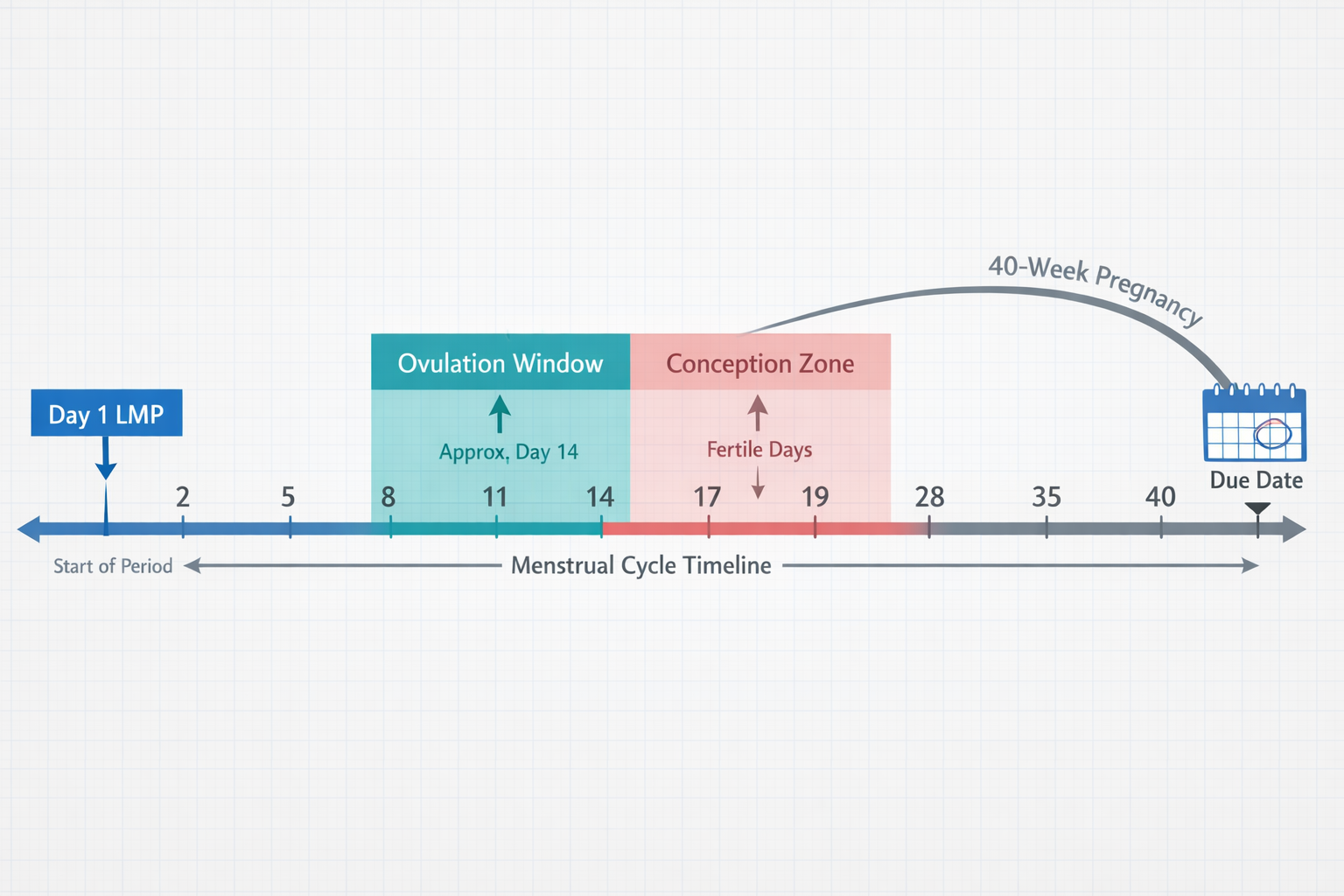
Conception happens when a sperm fertilizes an egg. The egg is only viable for 12 to 24 hours after ovulation. Sperm, however, can survive in the fallopian tubes for up to 5 days (American College of Obstetricians and Gynecologists). This means conception can result from intercourse on any of the 5 days before ovulation, or on ovulation day itself.
Key biological facts:
- Ovulation typically occurs around Day 14 of a 28-day cycle, but this varies widely.
- The egg lives for 12–24 hours post-ovulation.
- Sperm survival: up to 5 days in fertile cervical mucus.
- The fertile window is approximately 6 days total.
"Conception date" refers to the day the egg was fertilized, which may be 1–5 days after the intercourse that caused it.
This distinction matters when you're calculating backward from a known date. For more on how these two events differ, see our guide on conception date vs. ovulation date.
How to Calculate Conception Date (Step-by-Step Guide): Method 1 — Using Your Last Menstrual Period
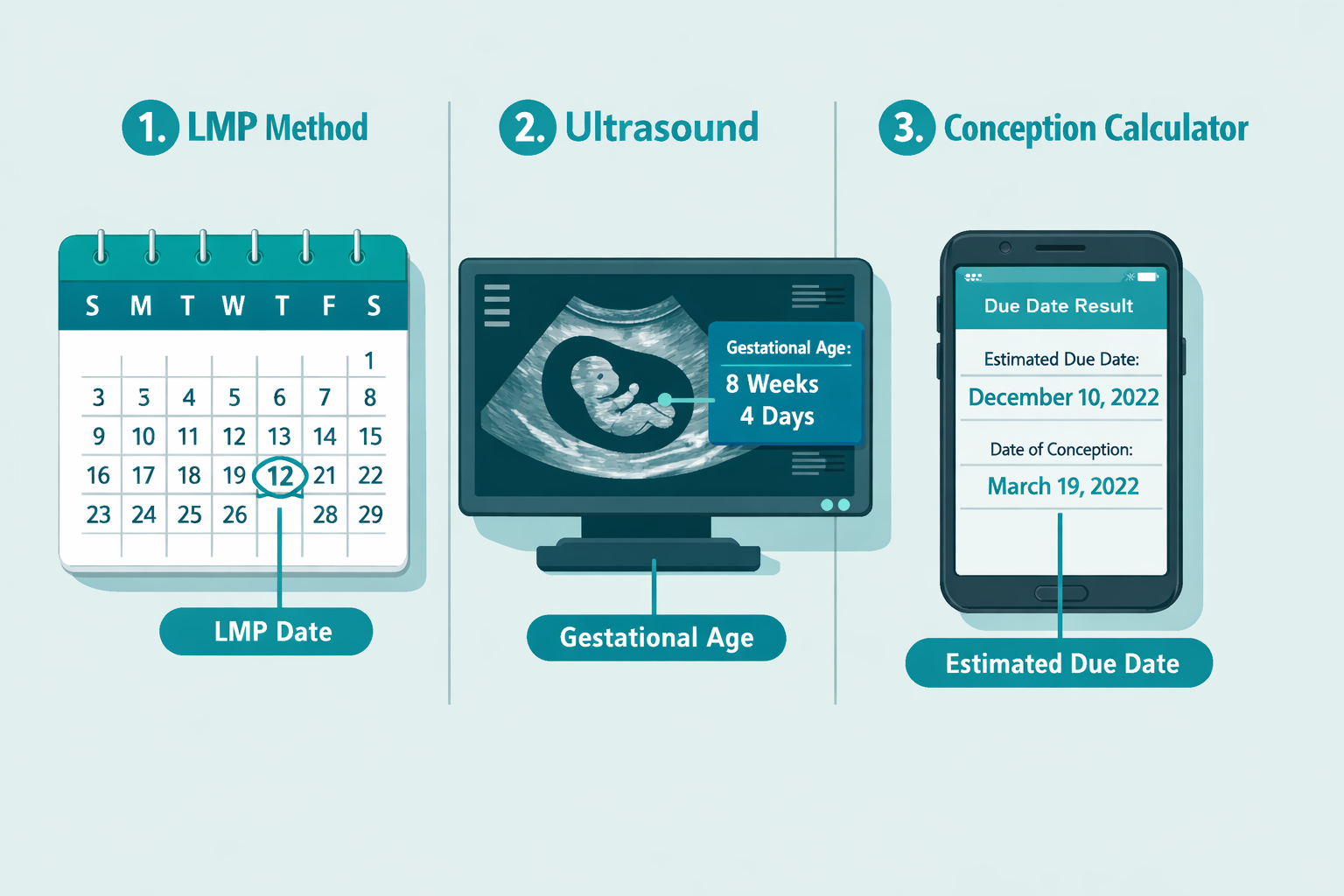
The LMP method is the most widely used starting point. Add 14 days to the first day of your last menstrual period to estimate ovulation, which is also your estimated conception date.
Step-by-Step: LMP Method
- Identify Day 1 of your last menstrual period. This is the first day of actual bleeding, not spotting.
- Add 14 days. For a standard 28-day cycle, this lands on your estimated ovulation date.
- That date is your estimated conception window. Conception likely occurred within 1–3 days of this date.
Example:
- LMP: January 1, 2026
- Add 14 days → January 15, 2026 (estimated ovulation/conception date)
- Estimated conception window: January 12–15, 2026
Adjusting for Cycle Length
If your cycle is not 28 days, the formula shifts:
| Cycle Length | Ovulation Day (approx.) | Adjustment from Day 14 |
|---|---|---|
| 24 days | Day 10 | −4 days |
| 28 days | Day 14 | 0 days |
| 32 days | Day 18 | +4 days |
| 35 days | Day 21 | +7 days |
Common mistake: Using the last day of your period instead of the first day as your starting point. Always use Day 1 of bleeding.
Use our cycle length calculator to find your average cycle length before applying this formula.
How to Calculate Conception Date (Step-by-Step Guide): Method 2 — Working Backward from Your Due Date
If you already know your due date, you can reverse-engineer your conception date. Subtract 266 days (38 weeks) from your due date to estimate when fertilization occurred.
Step-by-Step: Due Date Method
- Start with your confirmed due date.
- Subtract 266 days (38 weeks). This represents the average time from conception to birth.
- The resulting date is your estimated conception date.
Example:
- Due date: October 8, 2026
- Subtract 266 days → January 15, 2026 (estimated conception date)
Note: Due dates are themselves estimates. The standard 40-week pregnancy is counted from LMP, not from conception. So if your provider gave you a due date based on LMP, subtract 280 days from that due date to get back to your LMP, then add 14 days to get conception.
For a deeper look at how reliable this reverse calculation is, read our conception date accuracy guide.
You can also use our due date calculator to run these numbers automatically.
Method 3 — Using Ultrasound Data
First-trimester ultrasound is the most accurate clinical tool for estimating conception date. A sonographer measures the crown-rump length (CRL) of the embryo and matches it to gestational age charts.
- Best accuracy window: 6 to 12 weeks of pregnancy (margin of error: ±3–5 days).
- After 12 weeks, accuracy decreases because fetal size varies more between individuals.
- The ultrasound gives gestational age in weeks and days, which you can subtract from the scan date to estimate conception.
Example: Ultrasound at 8 weeks 3 days on February 5, 2026 → conception estimated around December 5, 2025.
For a full explanation of how this works clinically, see how ultrasound estimates conception date.
Using a Conception Calculator
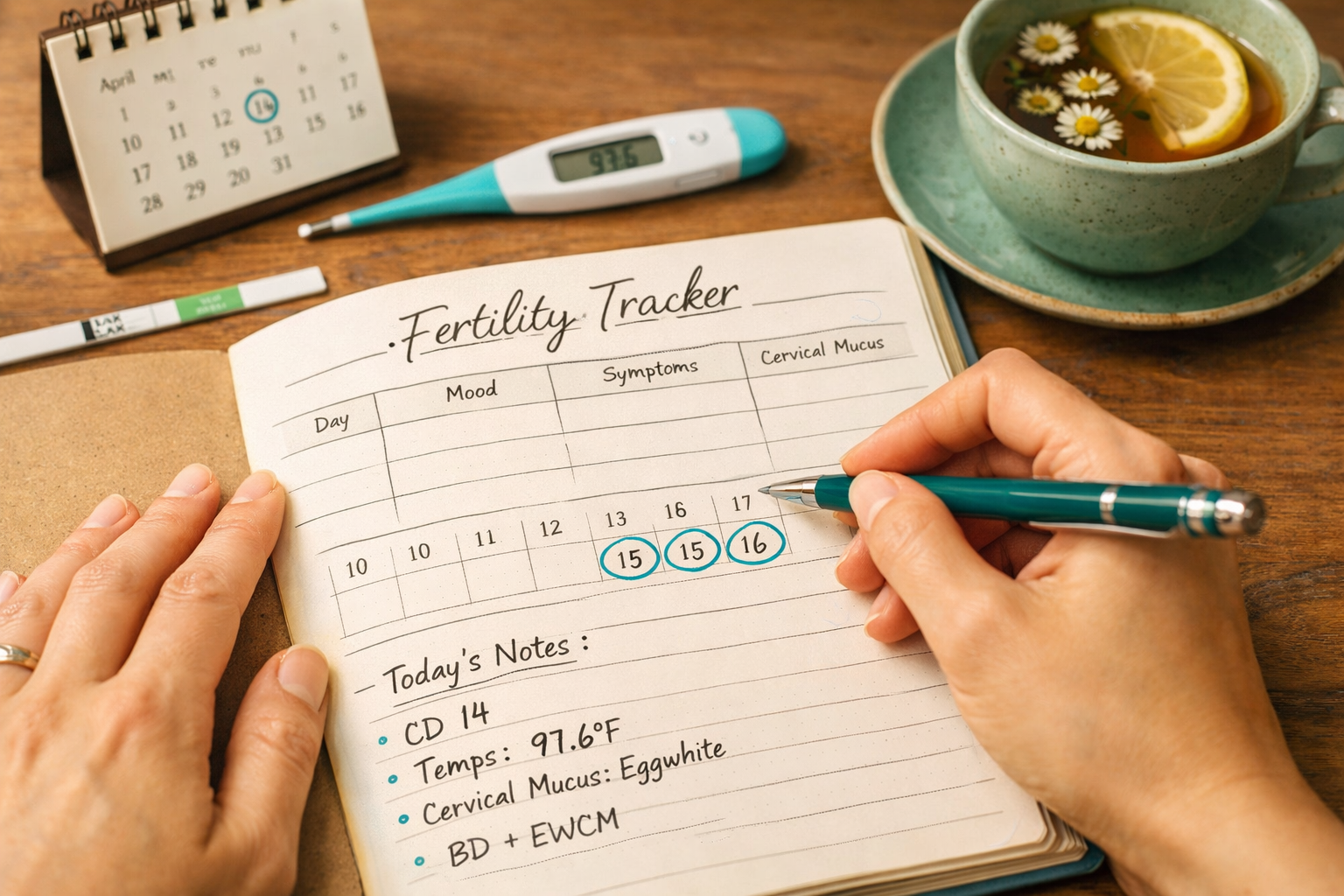
Online conception calculators apply the same formulas automatically, reducing manual calculation errors. They typically ask for your LMP, average cycle length, or due date, then output an estimated conception window.
Our accurate conception calculator walks through this in seconds. You can also use the when did I conceive calculator if you're working backward from a known due date.
Choose a calculator if:
- Your cycle length is irregular.
- You want a date range rather than a single day.
- You're comparing multiple possible conception windows.
What Affects Conception Date Accuracy?
Several factors can shift your estimated conception date by days or even weeks:
- Irregular cycles: If you have late ovulation, your conception date will be later than the standard formula predicts.
- Stress, illness, or hormonal changes: These can delay ovulation within a given cycle.
- Sperm survival: Conception may occur up to 5 days after the relevant intercourse.
- Implantation timing: Implantation happens 6–12 days after fertilization and does not affect the conception date itself, but it affects when a pregnancy test turns positive.
If you suspect you ovulated later than usual, our guide on what causes late ovulation explains the most common reasons.
Can You Know the Exact Day You Conceived?
Rarely, and only under specific conditions. You would need confirmed ovulation tracking (via LMP, basal body temperature, or ovulation predictor kits) combined with a single known intercourse date within the fertile window.
Even then, because sperm can survive several days, the exact fertilization moment remains uncertain. For a thorough look at this question, see can you know the exact day you conceived.
FAQ
Q: Is conception date the same as ovulation date? A: Usually yes, or within 24 hours. Ovulation releases the egg; conception happens when sperm fertilizes it, typically on the same day or the day after. See our full breakdown of conception date vs. ovulation date.
Q: Can I conceive before ovulation? A: Yes. Sperm deposited up to 5 days before ovulation can still fertilize the egg once it's released. This is why the fertile window starts several days before ovulation day.
Q: How accurate is the LMP method? A: It's a reasonable estimate for women with regular 28-day cycles, but it can be off by a week or more if your cycle length varies. Ultrasound is more accurate.
Q: What if I have irregular periods? A: The LMP method is less reliable. Ultrasound dating or ovulation tracking tools (like OPKs or basal body temperature charts) give better results.
Q: Does conception date affect my due date? A: Yes. Your due date is calculated as 266 days after conception (or 280 days after LMP). If your conception date shifts, your due date shifts too.
Q: Can two different conception dates result in the same due date? A: Dates within the same fertile window (a few days apart) will produce nearly identical due dates since the difference is smaller than the margin of error in due date calculations.
Q: How do I calculate conception date from a due date? A: Subtract 266 days from your due date. That gives you the estimated conception date.
Q: Is a conception calculator the same as a due date calculator? A: They use the same data but in opposite directions. A due date calculator takes your LMP or conception date and outputs a due date. A conception calculator takes your due date or LMP and outputs a conception window.
Conclusion
Calculating your conception date comes down to three reliable approaches: the LMP + 14 days formula, working backward 266 days from your due date, or using first-trimester ultrasound measurements. Each method has a margin of error, and that's normal. Biology doesn't work on a single fixed day.
Actionable next steps:
- Find your LMP date and apply the formula above for a quick estimate.
- Use our conception calculator to get a personalized date range.
- If you have an ultrasound report, cross-check the gestational age against your calculated date.
- Track your next cycle with an ovulation symptoms checker for more precise future planning.
- If your cycles are irregular, read up on late ovulation before relying on a standard 28-day formula.
The goal isn't a perfect answer. It's a confident, well-reasoned estimate that helps you and your provider make informed decisions throughout your pregnancy.
References
- American College of Obstetricians and Gynecologists. (2017). Methods for Estimating the Due Date. Committee Opinion No. 700. https://www.acog.org/clinical/clinical-guidance/committee-opinion/articles/2017/05/methods-for-estimating-the-due-date
- Wilcox, A.J., Weinberg, C.R., & Baird, D.D. (1995). Timing of sexual intercourse in relation to ovulation. New England Journal of Medicine, 333(23), 1517–1521. https://doi.org/10.1056/NEJM199512073332301
- Fehring, R.J., Schneider, M., & Raviele, K. (2006). Variability in the phases of the menstrual cycle. Journal of Obstetric, Gynecologic & Neonatal Nursing, 35(3), 376–384. https://doi.org/10.1111/j.1552-6909.2006.00051.x