Last updated: March 6, 2026
The desire to understand every detail of a new life's beginning is natural, and for many hopeful parents, a common question arises: "Can you know the exact day you conceived?" While pinpointing the precise moment of conception can be incredibly challenging due to the intricate biological processes involved, it is possible to narrow down a fertile window and estimate the conception date with varying degrees of accuracy. This comprehensive guide will explore the factors influencing conception timing, the methods available for estimation, and what you can realistically expect in 2026.
Key Takeaways
- Exact Day is Rare: Pinpointing the exact moment of conception is usually impossible due to sperm viability and the egg's lifespan.
- Fertile Window is Key: Conception occurs within a 6-day fertile window: 5 days leading up to ovulation and the day of ovulation itself.
- Ovulation is Central: The most accurate way to estimate conception is by identifying the day of ovulation.
- Methods Vary in Accuracy: Tracking methods like ovulation predictor kits (OPKs) and basal body temperature (BBT) charting offer better estimates than relying solely on the last menstrual period (LMP).
- Medical Confirmation: Ultrasounds, especially early ones, provide the most reliable medical estimation of conception and due dates.
- Sperm Longevity Matters: Sperm can live inside the female reproductive tract for up to 5 days, making it difficult to pinpoint the exact intercourse that led to conception.
- Implantation is Separate: Conception (fertilization) is distinct from implantation, which occurs several days later.
Quick Answer
No, you generally cannot know the exact day you conceived with 100% certainty. While you can identify the fertile window and the probable day of ovulation, which is critical for conception, the actual fertilization of the egg by sperm is a microscopic event that typically occurs within a 24-hour window after ovulation but can be influenced by when intercourse took place relative to that ovulation. The best you can achieve is a highly accurate estimation.
What is Conception and Why Is Pinpointing It So Difficult?
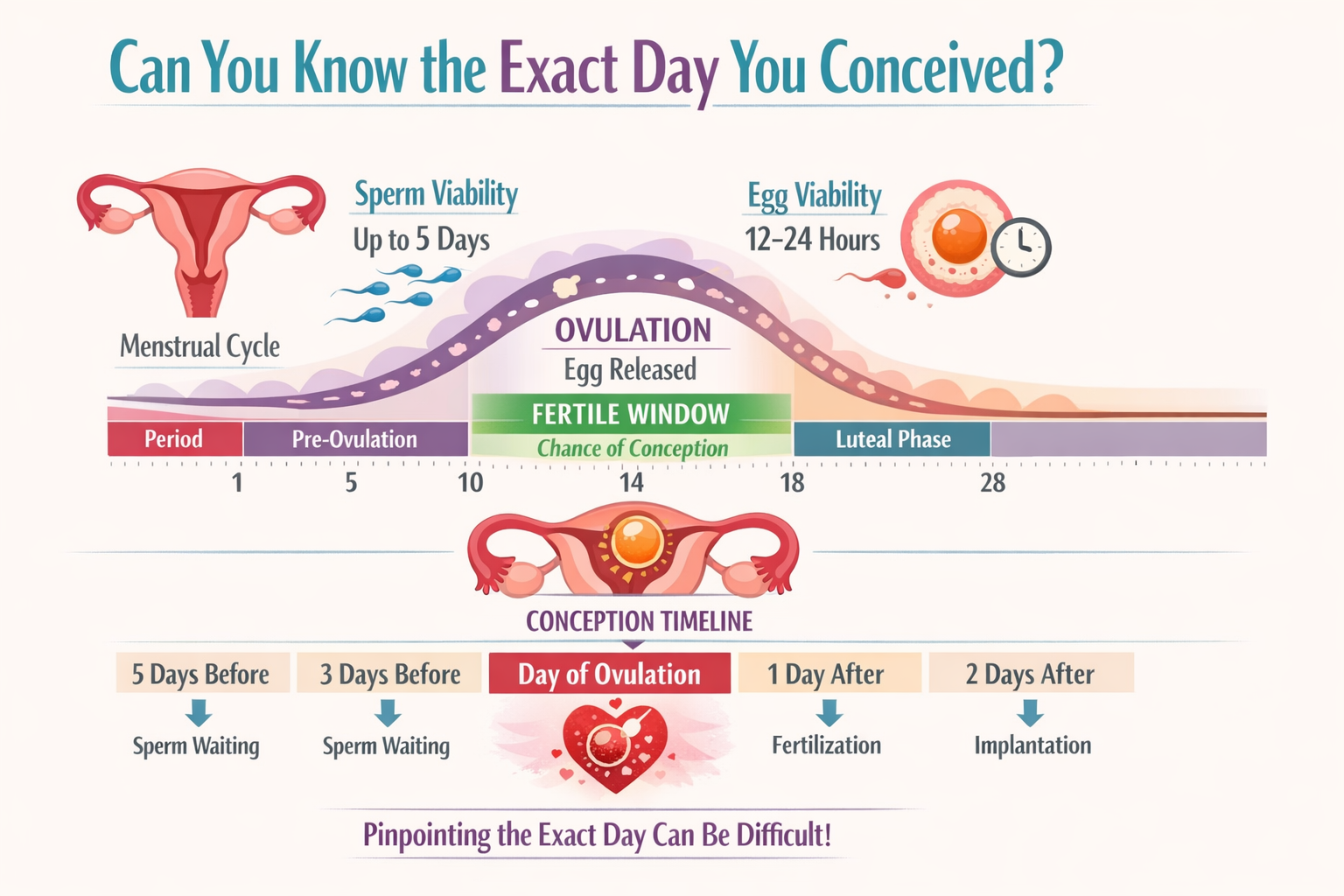
Conception is the moment a sperm successfully fertilizes an egg, leading to the formation of a zygote. Pinpointing the exact day of conception is difficult primarily because of the variable lifespan of both sperm and egg, coupled with the process of ovulation. Sperm can survive inside the female reproductive tract for up to five days, while an egg is viable for only 12 to 24 hours after ovulation. This means that conception can occur up to five days after intercourse, or immediately following intercourse if it happens around ovulation.
To understand why the exact day is elusive, consider these biological factors:
- Sperm Viability: After ejaculation, sperm can remain alive and capable of fertilizing an egg for an average of 3-5 days, though some can survive longer. This means intercourse on Monday could lead to conception on Thursday.
- Egg Viability: Once released from the ovary, an egg is only viable for fertilization for a very short period—typically 12 to 24 hours. If fertilization doesn't occur within this timeframe, the egg degenerates.
- Ovulation Variability: While a "typical" cycle might see ovulation around day 14, this can vary significantly between individuals and even cycle to cycle for the same person. Factors like stress, diet, and underlying health conditions can influence ovulation timing, leading to late ovulation or irregular cycles.
- The Fertile Window: The fertile window is defined as the 5 days leading up to ovulation and the day of ovulation itself. Intercourse during any of these 6 days can result in pregnancy. If you had intercourse multiple times within this window, it's impossible to know which specific act led to fertilization.
Decision Rule: If you are trying to conceive, focus on identifying your fertile window rather than the exact day. If you are trying to avoid pregnancy, assume sperm viability for up to 5 days after unprotected intercourse.
How Can You Estimate Your Conception Date?

While precise timing is challenging, several methods allow you to estimate your conception date with varying degrees of accuracy. The most reliable estimates stem from knowing your ovulation day.
Here are the primary methods:
1. Tracking Ovulation
Knowing when you ovulate is the most accurate non-medical way to estimate your conception date. Ovulation usually occurs roughly 14 days before your next period, but this can vary.
- Ovulation Predictor Kits (OPKs): These kits detect a surge in Luteinizing Hormone (LH), which typically happens 24-36 hours before ovulation. A positive OPK indicates you are likely to ovulate soon. Using an OPK helps identify your fertile window and narrow down the day of ovulation. You can learn more about identifying your most fertile days with an Easy Ovulation Calculator.
- Basal Body Temperature (BBT) Charting: BBT charting involves taking your temperature every morning before getting out of bed. A slight rise in BBT (0.5-1 degree Fahrenheit) that stays elevated for several days indicates that ovulation has occurred. This method confirms ovulation after it happens.
- Cervical Mucus Monitoring: Changes in cervical mucus throughout your cycle can indicate fertility. "Egg-white" consistency mucus is typically present just before and during ovulation, facilitating sperm travel.
- Ovulation Symptoms: Some women experience ovulation symptoms like mild cramping (mittelschmerz), breast tenderness, or light spotting. However, these are less reliable indicators than OPKs or BBT. For a detailed understanding, review our guide on late ovulation symptoms.
Quick Example: If your OPK showed a positive result on March 15th, and you likely ovulated on March 16th, your conception date would most probably be March 16th or 17th.
2. Last Menstrual Period (LMP)
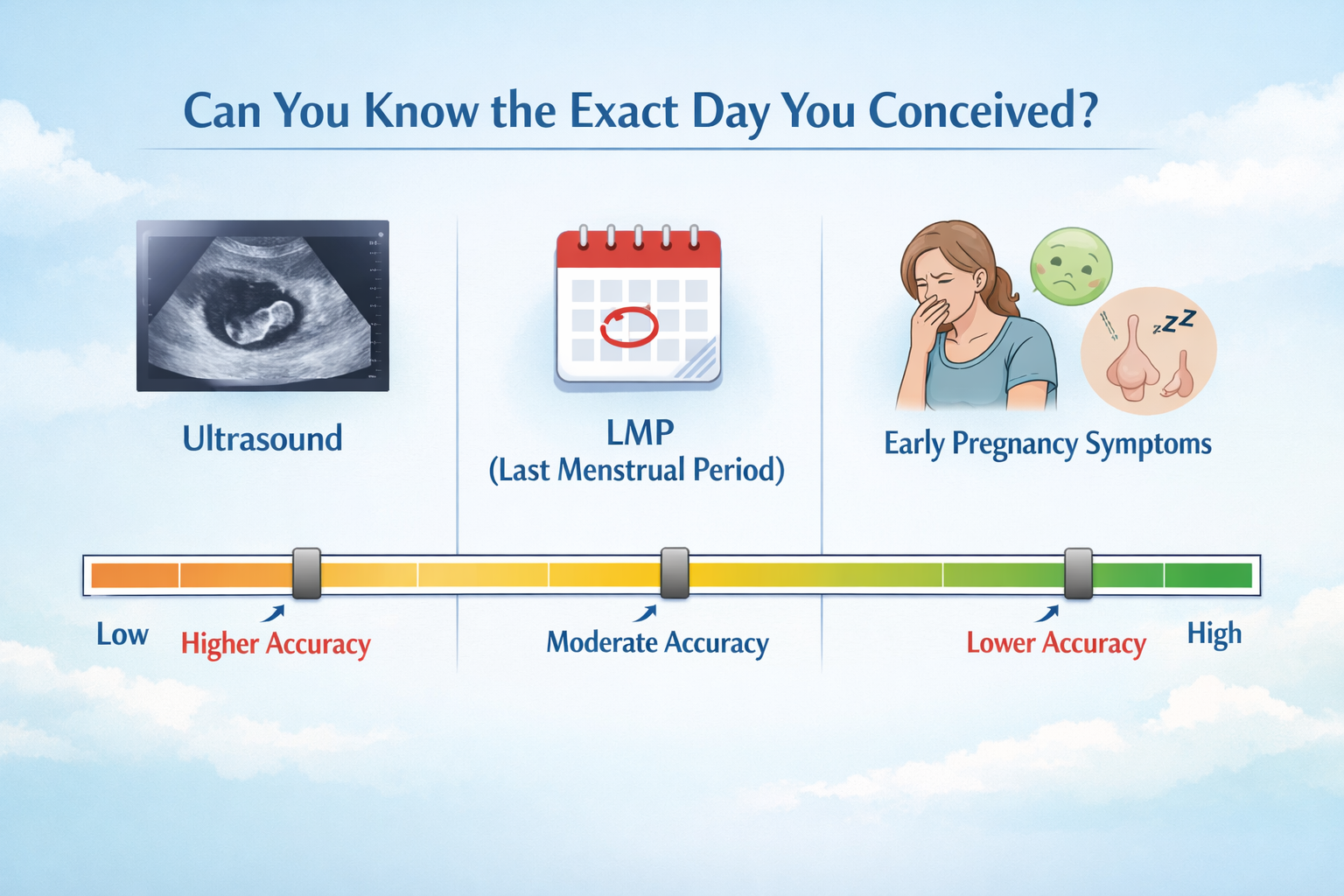
Healthcare providers often use the date of your last menstrual period (LMP) to estimate your due date. Based on the assumption of a typical 28-day cycle with ovulation on day 14, conception is assumed to have occurred approximately 14 days after your LMP.
- Calculation: Add 280 days (40 weeks) to the first day of your LMP to get an estimated due date. Then, count back 38 weeks from that due date to approximate the conception date.
- Accuracy: This method is an estimate and can be inaccurate if your cycle is irregular, longer, or shorter than 28 days, or if you ovulated earlier or later than day 14. This method essentially estimates the middle of your fertile window rather than the precise day.
3. Early Pregnancy Ultrasound
For the most accurate medical estimation, an early pregnancy ultrasound is invaluable.
- Crown-Rump Length (CRL): During the first trimester (typically between 6 and 12 weeks), a healthcare provider measures the embryo's crown-rump length (CRL). This measurement is highly consistent in early pregnancy and provides a very accurate estimation of gestational age and, by extension, the conception date.
- Accuracy: Early ultrasounds are generally considered the most reliable method for dating a pregnancy, often more accurate than LMP, especially if there's uncertainty about the last period or cycle regularity.
Common Mistake: Relying solely on your LMP for conception date if your cycles are irregular. Always communicate cycle length variations to your healthcare provider.
Medical Confirmations and Due Date Calculations
Medical professionals utilize a combination of methods, with early ultrasound being the gold standard for confirming gestational age and, consequently, the estimated conception and due date.
- Gestational Age: This is calculated from the first day of your last menstrual period (LMP). It includes the two weeks before ovulation, so a baby born at 40 weeks gestational age has actually been developing for about 38 weeks since conception.
- Fetal Age (Conception Age): This refers to the actual age of the fetus from the moment of fertilization. It is typically two weeks less than the gestational age. When we talk about knowing the day you conceived, we are referring to fetal age.
- Due Date Calculation: The due date is most commonly calculated using Naegele's Rule, which adds one year, subtracts three months, and adds seven days to the first day of your LMP. This assumes a 28-day cycle and a 40-week pregnancy. However, if an early ultrasound provides a significantly different due date (more than 5-7 days discrepancy), the ultrasound-derived due date usually takes precedence.
Table: Methods for Estimating Conception Date
| Method | How It Works | Accuracy Level | Best For |
|---|---|---|---|
| Ovulation Tracking (OPKs, BBT) | Detects LH surge or confirms ovulation post-event. | High (narrows to a 1-2 day window) | Actively trying to conceive; identifying fertile window. |
| Last Menstrual Period (LMP) | Counts 14 days from LMP, assuming a standard cycle. | Moderate (less reliable with irregular cycles) | Initial estimation; regular cycles. |
| Early Pregnancy Ultrasound | Measures embryo/fetus size (CRL) to determine gestational age. | Very High (especially in first trimester) | Most reliable medical confirmation of gestational age and due date; often recalculates conception date. |
| Conception Calculators | Uses LMP, cycle length, or due date to back-calculate a potential conception date. | Moderate to High (depends on input accuracy) | Quick estimate, but rely on user input and assumptions. Try our Conception Date Calculator for a personalized estimate. |
Factors That Make Pinpointing Conception Difficult
Despite modern fertility tracking and medical advancements, several factors can make it extremely difficult to pinpoint the exact day you conceived.
- Sperm Longevity: As mentioned, sperm can live for up to five days in the reproductive tract. This means if you had unprotected intercourse on Monday, Wednesday, and Friday, and ovulated on Saturday, conception could have resulted from any of those acts of intercourse.
- Irregular Menstrual Cycles: Women with irregular cycles, or conditions like Polycystic Ovary Syndrome (PCOS), may ovulate unpredictably. This makes using LMP for dating very unreliable and tracking ovulation more challenging. Understanding what causes late ovulation can highlight these difficulties.
- Multiple Acts of Intercourse: For couples actively trying to conceive, having intercourse every day or every other day during the fertile window is common. While this increases the chances of pregnancy, it makes it impossible to know which specific instance led to fertilization.
- Late Implantation: While conception is the fertilization of the egg, implantation (when the fertilized egg attaches to the uterine wall) occurs 6-12 days after conception. Pregnancy symptoms and positive pregnancy tests usually appear after implantation. If implantation occurs later in this window, it can sometimes obscure the estimated timing of conception if relying on the first positive test. For more, explore when implantation occurs after ovulation.
- Uncertainty of Ovulation: Even with tracking methods like OPKs, there can be some ambiguity. An LH surge indicates ovulation will happen, not that it has. And BBT confirms it after the fact. While these narrow the window significantly, they don't give the precise hour of egg release and fertilization.
Edge Case: If you had only one instance of unprotected intercourse in an entire cycle and then became pregnant, and you accurately know your ovulation day, you can get very close to knowing the exact conception day. However, this is an ideal and rare scenario.
Why Knowing Your Conception Date Matters (and Why It Doesn't Always)
While the quest to know the exact day you conceived is often driven by curiosity and a desire for control, its practical importance varies.
Why it matters:
- Due Date Accuracy: The primary medical reason for estimating conception is to establish an accurate due date. This helps healthcare providers monitor fetal growth, schedule important screenings, and plan for delivery. An accurate due date prevents unnecessary inductions or interventions based on incorrect timing.
- Paternity Determination: In rare circumstances, knowing the approximate conception date can be relevant for paternity cases.
- Emotional Connection: For some parents, knowing the approximate conception date deepens their emotional connection to the earliest stages of their baby's development.
- Understanding Your Cycle: For those trying to conceive, actively tracking and estimating conception helps them understand their unique cycle patterns, which can be empowering. You can find more insights on this via our Fertile Window Calculator.
Why it doesn't always matter (or is less critical):
- Medical Management: For most medical purposes, an accurate due date derived from LMP and confirmed by early ultrasound is sufficient. The precise day of conception is less critical than the overall gestational age.
- Fetal Development Stages: Fetal development is tracked in weeks of gestational age, not from the exact conception day. The baby will follow a predictable growth pattern regardless of whether you know the precise moment of fertilization.
- Reducing Stress: Obsessing over the exact day can add unnecessary stress to the journey of conception and pregnancy. Focusing on the fertile window and enjoying the process can be more beneficial.
- Natural Variation: Even with the most precise tracking, babies rarely arrive on their exact due date. Most births occur within a two-week window before or after the estimated due date.
Actionable Next Step: If you are early in your pregnancy and concerned about dating accuracy, schedule an early ultrasound with your healthcare provider. This will provide the most reliable estimate of your gestational age and due date.
Conclusion
The question, "Can you know the exact day you conceived?" often arises from a deep desire to understand the very beginning of a new life. While pinpointing the precise moment of fertilization is biologically complex and usually impossible due to factors like sperm longevity and the brief lifespan of the egg, you can absolutely narrow down the fertile window and obtain a highly accurate estimation of your conception date.
Methods like ovulation predictor kits (OPKs), basal body temperature (BBT) charting, and cervical mucus monitoring empower individuals to identify their most fertile days. For medical confirmation and the most reliable estimate of gestational age and due date, an early pregnancy ultrasound is the gold standard. Ultimately, while the exact day may remain a beautiful mystery, understanding your body's cycle and utilizing available tools allows for a confident estimation, supporting both informed family planning and medical care throughout your pregnancy journey in 2026.
Related Reading
- Conception Date Calculator – Find When You Conceived or Your Due Date
- Fertile Window Calculator: Maximize Conception in 2025
- Pregnancy Chances After One Unprotected Act (2026 Guide)
FAQ

Q1: What is the fertile window? A1: The fertile window is the 6-day period during which conception is possible, encompassing the 5 days leading up to ovulation and the day of ovulation itself.
Q2: How long do sperm live in the female body? A2: Sperm can typically survive in the female reproductive tract for up to 3-5 days, with some surviving longer under optimal conditions.
Q3: How long is an egg viable after ovulation? A3: An egg is viable for fertilization for a short period, generally 12 to 24 hours, after it is released from the ovary.
Q4: Which method is most accurate for estimating conception? A4: An early pregnancy ultrasound (especially between 6-12 weeks) is medically the most accurate method for dating a pregnancy and estimating conception.
Q5: Can I get pregnant from intercourse 5 days before ovulation? A5: Yes, because sperm can live for up to 5 days, intercourse up to 5 days before ovulation can lead to conception.
Q6: What is the difference between gestational age and fetal age? A6: Gestational age is calculated from the first day of your last menstrual period (LMP) and is typically two weeks longer than fetal age, which is the actual age from conception.
Q7: Does an irregular cycle affect my ability to know when I conceived? A7: Yes, irregular cycles make it much harder to estimate conception using the LMP method, as ovulation timing becomes unpredictable. Ovulation tracking is more crucial in these cases.
Q8: Can implantation bleeding help pinpoint conception? A8: No, implantation bleeding occurs 6-12 days after conception when the fertilized egg attaches to the uterine wall. It doesn't help pinpoint the exact day of fertilization itself.
Q9: If I know my due date, can I work backward to find my conception date? A9: Yes, you can estimate your conception date by counting back approximately 38 weeks (266 days) from your due date.
Q10: Why do doctors use LMP to calculate due dates if it's less accurate than ultrasound? A10: LMP is a quick initial estimate. Ultrasounds are then used to confirm or adjust the due date, especially if the LMP-based date doesn't align with fetal measurements.
Sources
- American College of Obstetricians and Gynecologists (ACOG). (2017). Methods for Estimating the Due Date.
- National Institute of Child Health and Human Development (NICHD). (2023). How Long Does Sperm Live?
- Mayo Clinic. (2024). Ovulation: Calculating Your Most Fertile Time.