Navigating the complexities of fertility can be a maze of dates and biological processes. Understanding the precise distinctions between conception date and ovulation date is crucial for anyone trying to conceive, tracking a pregnancy, or simply understanding their reproductive health. These terms, while closely related, refer to distinct events in the journey to pregnancy, and knowing the Conception Date vs Ovulation Date: What’s the Difference? can empower you with clearer insights into your body's timing.
Key Takeaways
- Ovulation Date: This is the specific day an egg is released from the ovary, typically occurring once per menstrual cycle.
- Conception Date: This refers to the moment a sperm successfully fertilizes an egg, leading to the formation of a zygote.
- Timing Gap: Conception can only happen if unprotected intercourse occurs within the "fertile window" around ovulation, usually from a few days before ovulation up to the day of ovulation itself.
- Sperm Viability: Sperm can survive inside the female reproductive tract for up to 5 days, making intercourse days before ovulation potentially lead to conception.
- Egg Viability: An egg is viable for fertilization for only 12 to 24 hours after its release from the ovary.
- Due Date Calculation: Healthcare providers typically calculate a baby's due date based on the first day of the last menstrual period (LMP) or through ultrasound, as the exact conception date is often unknown.
- Tracking Benefits: Understanding both dates helps with fertility awareness, timing intercourse, and estimating gestational age more accurately.
- Variability: Both ovulation and conception timing can vary based on individual cycle length, regularity, and external factors.
Quick Answer
The ovulation date is the day an egg is released from the ovary, a single event in the menstrual cycle. The conception date, on the other hand, is the specific moment a sperm fertilizes that egg, which can occur on the ovulation day or up to 24 hours afterward if sperm are already present from intercourse in the days leading up to ovulation. The key difference lies in ovulation being the release of the egg, and conception being the fertilization of the egg by sperm.
What is Ovulation Date?
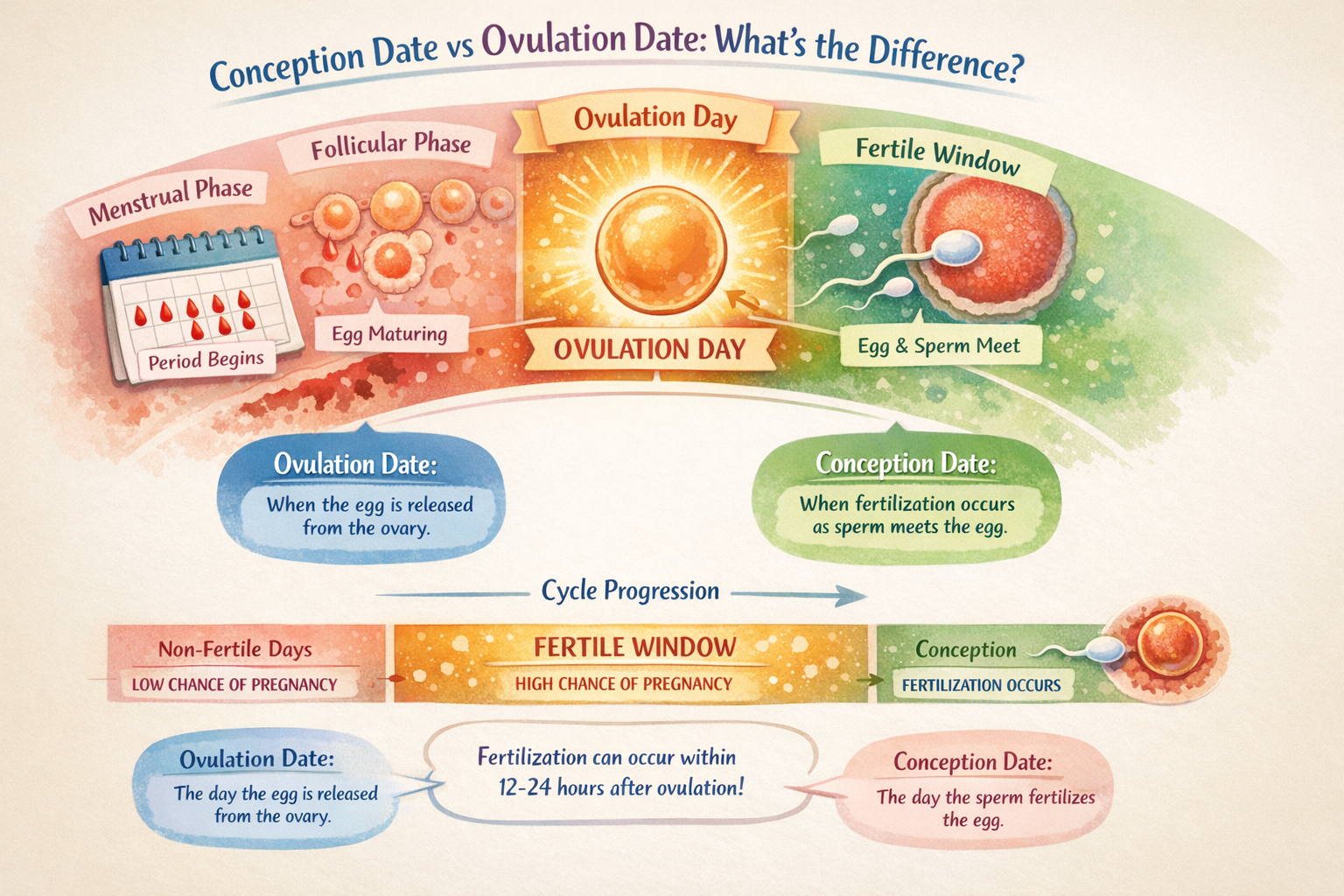
Ovulation date is the precise day when a mature egg is released from the ovary, ready to be fertilized. This event marks the most fertile period of a woman's menstrual cycle. For most women with a regular 28-day cycle, ovulation typically occurs around day 14, but this can vary significantly.
Ovulation is a critical step in the reproductive process, signaling the body's readiness for potential pregnancy. Without ovulation, conception cannot naturally occur. The egg, once released, travels down the fallopian tube, where it remains viable for fertilization for a limited time—generally between 12 and 24 hours. If fertilization does not happen within this window, the egg disintegrates, and the uterine lining prepares to shed during menstruation. Many women track their ovulation using methods like ovulation predictor kits (OPKs), basal body temperature (BBT) charting, or by observing cervical mucus changes. Tools like an Ovulation Symptoms Checker can also help identify this window.

When does ovulation typically occur?
- Typical Cycle: In an average 28-day menstrual cycle, ovulation usually takes place around day 14.
- Variable Cycles: For women with shorter or longer cycles, ovulation will occur earlier or later. For example, in a 24-day cycle, ovulation might be around day 10, while in a 35-day cycle, it could be around day 21.
- Hormonal Control: Ovulation is triggered by a surge in Luteinizing Hormone (LH), which can be detected with OPKs.
- Factors Affecting Timing: Stress, illness, travel, certain medications, and underlying health conditions can all influence ovulation timing, sometimes leading to late ovulation.
What is Conception Date?
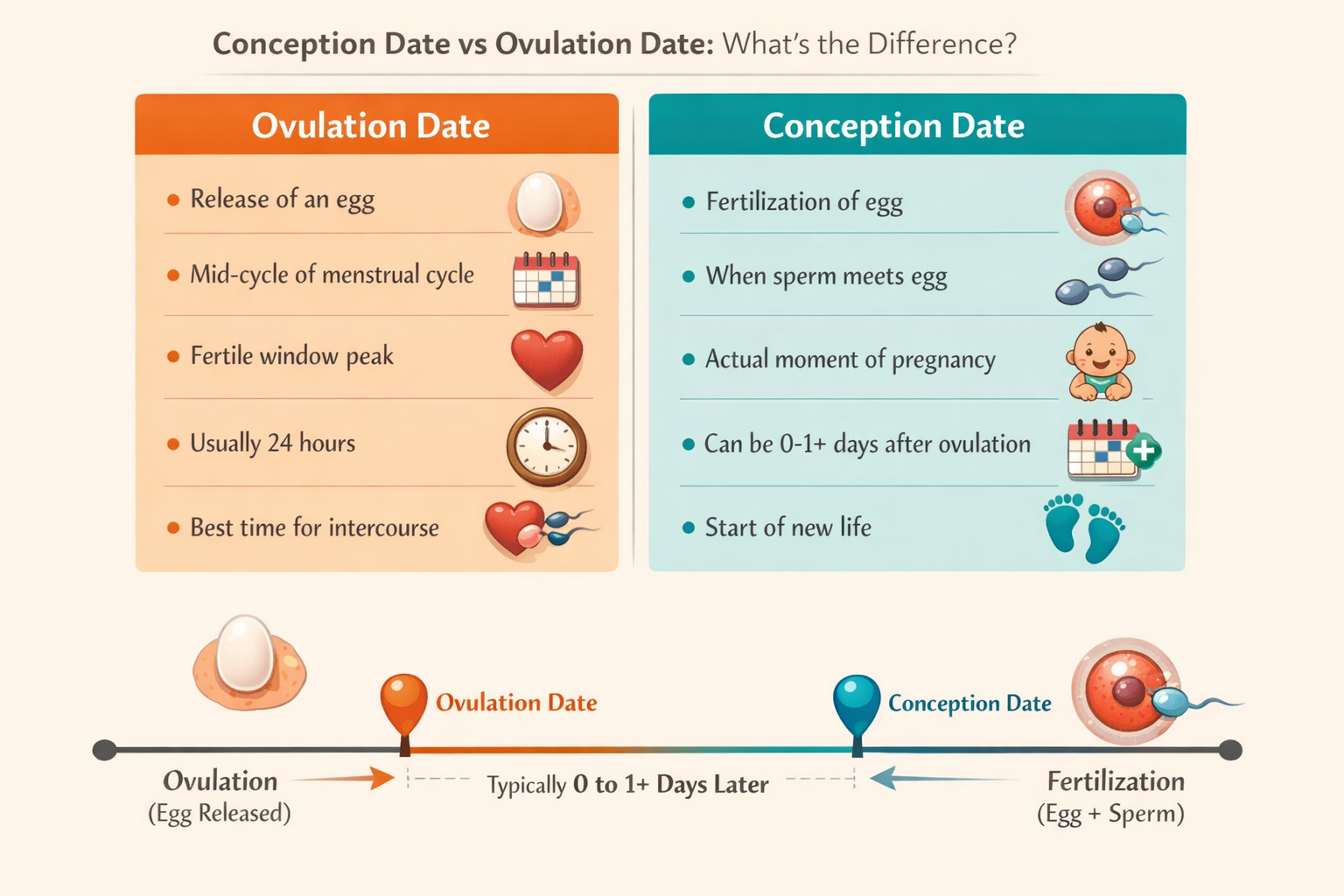
The conception date is the exact moment when a sperm successfully penetrates and fertilizes an egg, creating a single-celled zygote which is the very beginning of a new human life. This event initiates pregnancy and typically occurs within 12 to 24 hours after ovulation. However, because sperm can survive in the female reproductive tract for several days (up to 5 days), conception can happen from intercourse that occurred days before the actual ovulation.
Conception is not instantaneous with intercourse; it's the culmination of a journey for the sperm to reach and fertilize the newly released egg. If a couple has intercourse multiple times within the fertile window, pinpointing the exact moment of conception can be challenging without advanced medical intervention, making the "conception date" an estimation in most natural pregnancies. This is why doctors often rely on the Last Menstrual Period (LMP) for due date calculations. Our Conception Date Calculator can help estimate this window.

Key aspects of the Conception Date vs Ovulation Date: What’s the Difference?
| Feature | Ovulation Date | Conception Date |
|---|---|---|
| Definition | Day an egg is released from the ovary | Day a sperm fertilizes an egg |
| Timing | A single day in the menstrual cycle | Occurs within 12-24 hours after ovulation |
| Prerequisite | Occurs naturally as part of the menstrual cycle | Requires viable sperm to meet a viable egg |
| Predictability | Can be predicted with relative accuracy (OPKs, BBT) | Often estimated based on ovulation or intercourse |
| Duration | A single event | A single moment |
| Role in Pregnancy | Makes egg available for fertilization | Marks the actual beginning of pregnancy |
How Do Ovulation and Conception Dates Relate to Each Other?
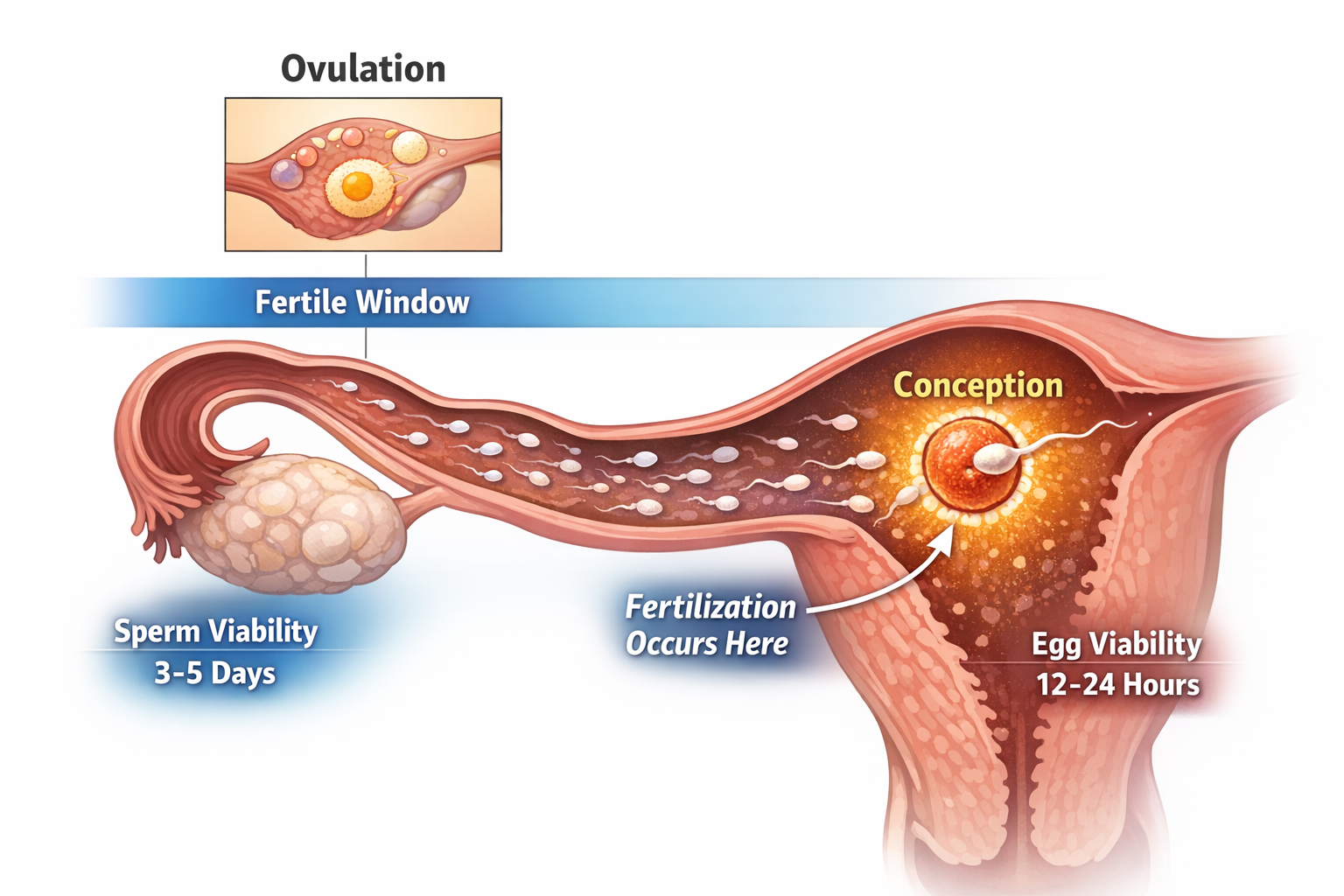
Ovulation and conception dates are intrinsically linked, with ovulation always preceding conception, yet they are distinct events. Conception can only occur if an egg is fertilized by sperm during the limited window when the egg is viable after ovulation.
The relationship between these dates defines the "fertile window." This window is typically about six days long, encompassing the five days leading up to ovulation and the day of ovulation itself. This extended window exists because sperm can survive in the female reproductive tract for up to five days, patiently waiting for an egg to be released. Once the egg is released, it only has about 12 to 24 hours to be fertilized. Therefore, if you have unprotected intercourse on day 10, and ovulate on day 14, conception could potentially occur on day 14 with sperm from day 10. Understanding this relationship is vital for couples trying to maximize their chances of pregnancy. Our Fertile Window Calculator can help you pinpoint these critical days.

Understanding the fertile window:
- Sperm Longevity: Sperm can live up to 5 days in the reproductive tract under optimal conditions.
- Egg Longevity: The egg lives for 12-24 hours after ovulation.
- Optimal Timing: Intercourse during the 2-3 days leading up to ovulation and on the day of ovulation itself offers the highest chance of conception.
- Conception Timing: The actual moment of fertilization (conception) usually happens very close to or on the day of ovulation, regardless of when intercourse occurred within the fertile window.
- Implantation: After conception, the fertilized egg travels to the uterus for implantation, which typically occurs 6-12 days after ovulation. You can learn more about when implantation occurs after ovulation.
Why is it Important to Know the Conception Date vs Ovulation Date: What’s the Difference?
Knowing the difference between your conception date and ovulation date is important for several reasons, from accurately dating a pregnancy to understanding fertility challenges. For individuals trying to conceive, pinpointing the ovulation date helps optimize intercourse timing, while the conception date is key for medical professionals to establish a precise gestational age and estimated due date.
Understanding the distinction empowers individuals to better interpret fertility tracking data, manage expectations, and communicate more effectively with healthcare providers. If a pregnancy results, the estimated due date is often calculated based on the last menstrual period (LMP) or ultrasound findings, as the precise conception date is often unknown. However, if ovulation was tracked diligently, an estimated conception date can provide a more accurate starting point for pregnancy dating, particularly for women with irregular cycles. For example, knowing you ovulated late can explain why your calculated due date might be different from an LMP-based estimate.

Benefits of distinguishing between the dates:
- Accurate Due Date Calculation: While most due dates are based on LMP, a known ovulation date can help refine the due date, especially for irregular cycles. Our Due Date Calculator uses this information.
- Optimizing Conception Chances: Knowing the ovulation date helps couples time intercourse effectively within the fertile window, increasing the likelihood of conception.
- Understanding Pregnancy Milestones: A more accurate conception date allows for better tracking of fetal development and critical pregnancy milestones.
- Investigating Infertility: If conception is delayed, understanding ovulation patterns can help identify potential issues, such as anovulation or irregular ovulation.
- Medical Procedures: For assisted reproductive technologies (ART) like IVF, precise knowledge of ovulation and fertilization timing is paramount.
- Legal/Paternity Cases: In rare circumstances, an accurate conception date can be relevant for legal purposes.
How to Determine Your Ovulation and Conception Dates
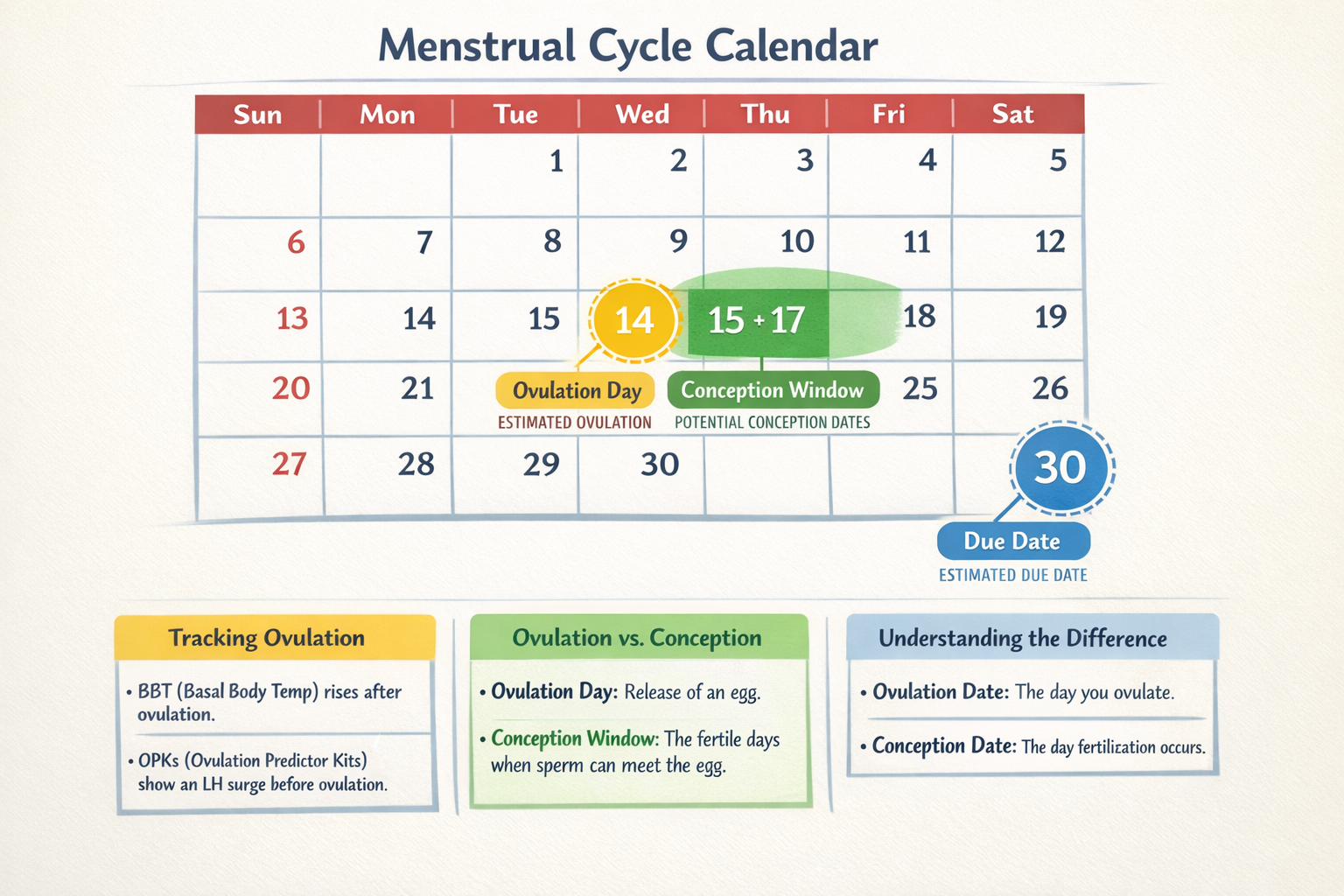
Determining your ovulation and conception dates involves a combination of tracking methods and, in some cases, medical assessment. While ovulation can be predicted with reasonable accuracy, the exact moment of conception is harder to pinpoint without advanced tools.
To determine ovulation, common methods include using ovulation predictor kits (OPKs) which detect the LH surge, charting basal body temperature (BBT) which shows a temperature rise after ovulation, and observing changes in cervical mucus. For more advanced tracking, an AI Ovulation Predictor can offer enhanced accuracy. Once ovulation is estimated, the conception date is then typically inferred to be within 12-24 hours of that ovulation date, especially if intercourse occurred within the fertile window. Healthcare providers often use ultrasound measurements in early pregnancy to estimate gestational age, which can give a more precise idea of conception timing than LMP alone, particularly for those with irregular cycles.

Methods for tracking and estimating:
- Ovulation Predictor Kits (OPKs): These detect the surge in Luteinizing Hormone (LH) that precedes ovulation by 24-36 hours. A positive OPK indicates you are likely to ovulate soon.
- Basal Body Temperature (BBT) Charting: Your resting body temperature typically rises by 0.5-1.0 degrees Fahrenheit shortly after ovulation and remains elevated until your next period. This confirms ovulation after it has happened.
- Cervical Mucus Monitoring: Changes in cervical mucus consistency (becoming clear, stretchy, and egg-white-like) indicate peak fertility leading up to ovulation.
- Fertility Tracking Apps: Many apps use algorithms based on your inputted cycle data, BBT, and OPK results to predict your fertile window and ovulation.
- Ultrasound: During early pregnancy, an ultrasound can measure the embryo/fetus to provide a more accurate gestational age and estimated due date, thus indirectly helping to estimate the conception date.
- Conception Date Calculator: These tools use your last menstrual period or estimated ovulation date to provide a likely conception window.
FAQ
Q: Can conception happen without ovulation? A: No, natural conception requires an egg to be released (ovulation) for fertilization by sperm.
Q: Is it possible to know the exact moment of conception? A: In natural conception, it's very difficult to know the exact moment. It's usually estimated within a 12-24 hour window after ovulation. For IVF, the exact fertilization time is known.
Q: Why do doctors use LMP instead of conception date for due dates? A: The Last Menstrual Period (LMP) is a more readily identifiable fixed point for most women, making it a standard and consistent method, even though it may not reflect the actual conception date directly.
Q: Does late ovulation mean late conception? A: Yes, if ovulation occurs later in your cycle, then conception will also occur later, leading to a later estimated due date than one based on a standard 28-day cycle. See our guide on late ovulation and pregnancy chances.
Q: Can intercourse on any day of my cycle lead to conception? A: No, conception can only happen if intercourse occurs during the fertile window, which is around ovulation, typically 5 days before ovulation and on the day of ovulation itself.
Q: How long after conception can a pregnancy test detect hCG? A: Pregnancy tests typically detect hCG around 10-14 days after conception, or roughly 7-10 days past ovulation (DPO), though some highly sensitive tests can detect it a few days earlier.
Q: Is the due date always 40 weeks from the LMP? A: The due date is typically estimated at 40 weeks from the LMP, but this is an average. It can vary based on individual cycle length and the actual timing of ovulation and conception.
Q: What is the fertile window? A: The fertile window is the period during the menstrual cycle when unprotected intercourse is most likely to result in pregnancy, usually encompassing the 5 days leading up to ovulation and the day of ovulation itself.
Q: Does intercourse timing within the fertile window affect the baby's sex? A: While some theories exist, there is no scientific evidence to conclusively prove that timing intercourse within the fertile window can reliably influence a baby's sex.
Conclusion
Understanding the distinct roles of the ovulation date and the conception date is fundamental for anyone interested in fertility and pregnancy in 2026. While the ovulation date signifies the release of an egg, offering a crucial window for fertilization, the conception date marks the actual, often elusive, moment a new life begins. Recognizing the Conception Date vs Ovulation Date: What’s the Difference? allows for more precise fertility tracking, optimized timing for conception, and more accurate pregnancy dating. By utilizing available tools and tracking methods, individuals can gain clearer insights into their unique reproductive journey, leading to more informed decisions and better communication with healthcare providers.
Related Reading
- Conception Date Calculator – Find When You Conceived or Your Due Date
- Due Date Calculator | Estimate Your Baby's Arrival Day
- Fertile Window Calculator | Find Your 6-Day Conception Window
- When Does Implantation Occur After Ovulation
- AI Ovulation Predictor | Advanced Fertility Tracking with Machine Learning