The journey from conception to implantation is a delicate dance of biological events, typically spanning about 6 to 12 days after ovulation. A conception implantation calculator helps individuals estimate the likely window for these crucial events, offering valuable insights into potential early pregnancy signs and optimal timing for pregnancy tests. While providing estimates, these tools utilize key dates like your last menstrual period (LMP) or known ovulation day to map out this critical early phase.
Key Takeaways
- A conception implantation calculator estimates the potential dates for fertilization and subsequent implantation of an embryo into the uterine wall.
- These calculators typically rely on your last menstrual period (LMP) or your ovulation date for their calculations.
- Conception usually occurs within 12-24 hours of ovulation, while implantation occurs 6-12 days after ovulation.
- Knowing your estimated implantation date can help you understand potential early pregnancy symptoms like implantation bleeding or cramping.
- It also guides the optimal timing for taking a home pregnancy test, as hCG levels become detectable after successful implantation.
- While useful, calculators provide estimates; actual dates can vary due to individual cycle variations.
- For the most accurate results, combine calculator use with other fertility tracking methods like ovulation predictor kits (OPKs) or basal body temperature (BBT) charting.
- Consult a healthcare professional for personalized advice and confirmation of pregnancy.
What is a Conception Implantation Calculator and How Does It Work?
A conception implantation calculator is an online tool designed to estimate the dates when conception might have occurred and when the fertilized egg (blastocyst) is likely to implant into the uterine lining. It works by taking your Last Menstrual Period (LMP) or your estimated ovulation date as primary inputs, then applying standard biological timelines for ovulation, fertilization, and implantation.
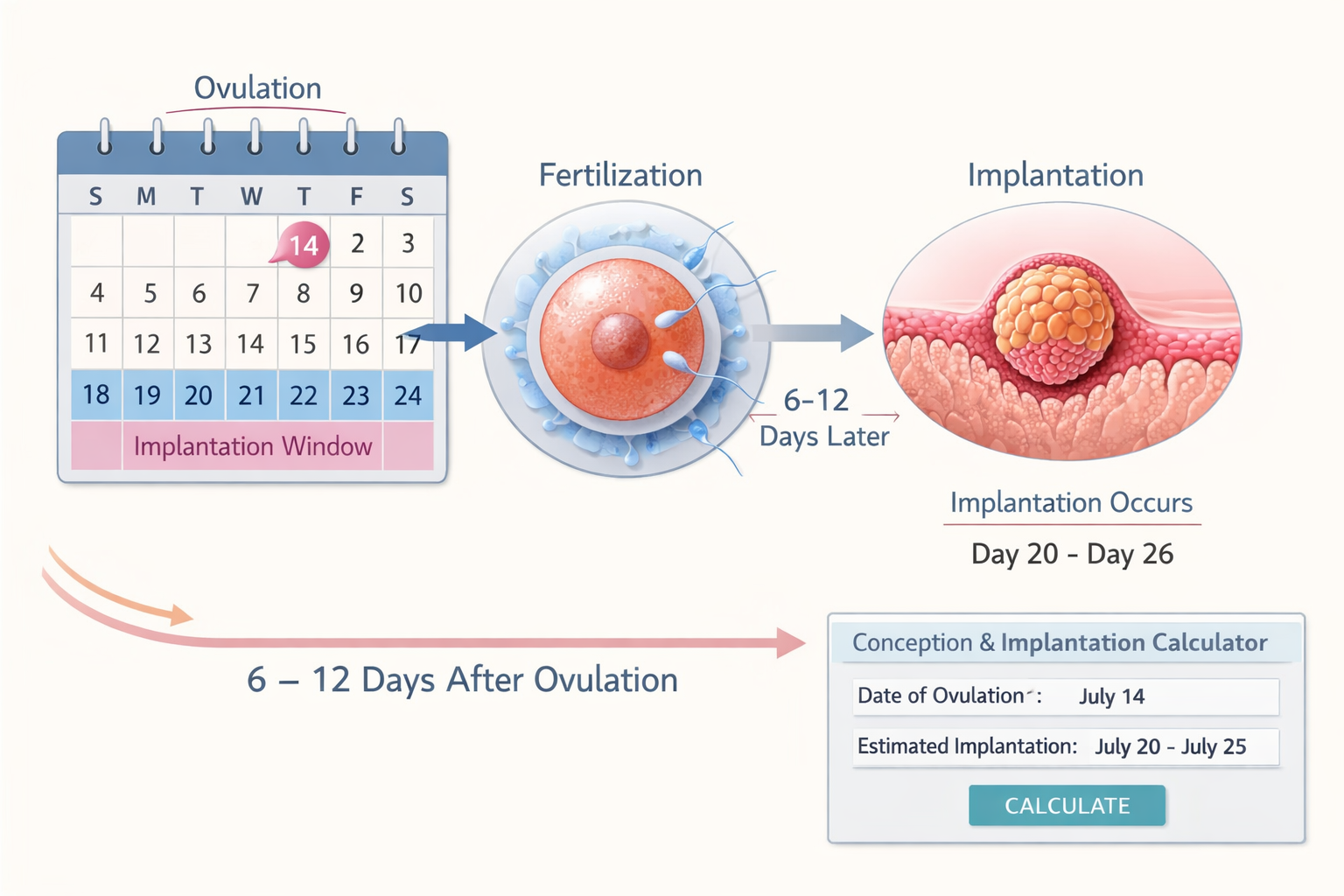
The process begins by identifying your ovulation date. If you provide your LMP, the calculator estimates ovulation based on an average menstrual cycle length (typically 28 days), assuming ovulation occurs around day 14. If you know your exact ovulation date, the calculator uses this as a more precise starting point. Conception (fertilization) is then estimated to occur within 12-24 hours after ovulation, as the egg has a limited lifespan. Following fertilization, the embryo travels down the fallopian tube to the uterus, a journey that takes several days. Implantation, the crucial step where the embryo attaches to the uterine wall, typically happens 6 to 12 days after ovulation, with the most common window being 8-10 days post-ovulation. Therefore, a calculator adds these standard intervals to your provided date to project the key conception and implantation timelines.
Key Phases Estimated by the Calculator
- Ovulation Date: The day an egg is released from the ovary. This is the starting point for fertilization.
- Conception Date: The day the egg is fertilized by sperm, usually within 12-24 hours post-ovulation. You can get a more precise estimate with our Accurate Conception Calculator.
- Implantation Date: The day the fertilized egg (now a blastocyst) attaches to the uterine wall. This typically occurs 6-12 days after ovulation. For more specific details, consider using an Implantation Calculator (DPO).
- Earliest Pregnancy Test Date: The date when enough hCG hormone might be present in your urine for a home pregnancy test to detect it, usually a few days after successful implantation.
For example, if your last menstrual period (LMP) started on January 1st, 2026, and you have a regular 28-day cycle, the calculator would estimate ovulation around January 14th. Conception would then be around January 14th-15th, and implantation would likely fall between January 20th and January 26th. If you know your ovulation date was precisely January 14th, the implantation window becomes more refined. These estimations are particularly helpful for those actively trying to conceive, providing a structured timeline.
How to Use a Conception Implantation Calculator for Best Results
To use a conception implantation calculator effectively, you need to provide accurate information, typically your last menstrual period (LMP) date or your ovulation date. The more precise your input, the more reliable the calculator's estimations will be for both conception and implantation.
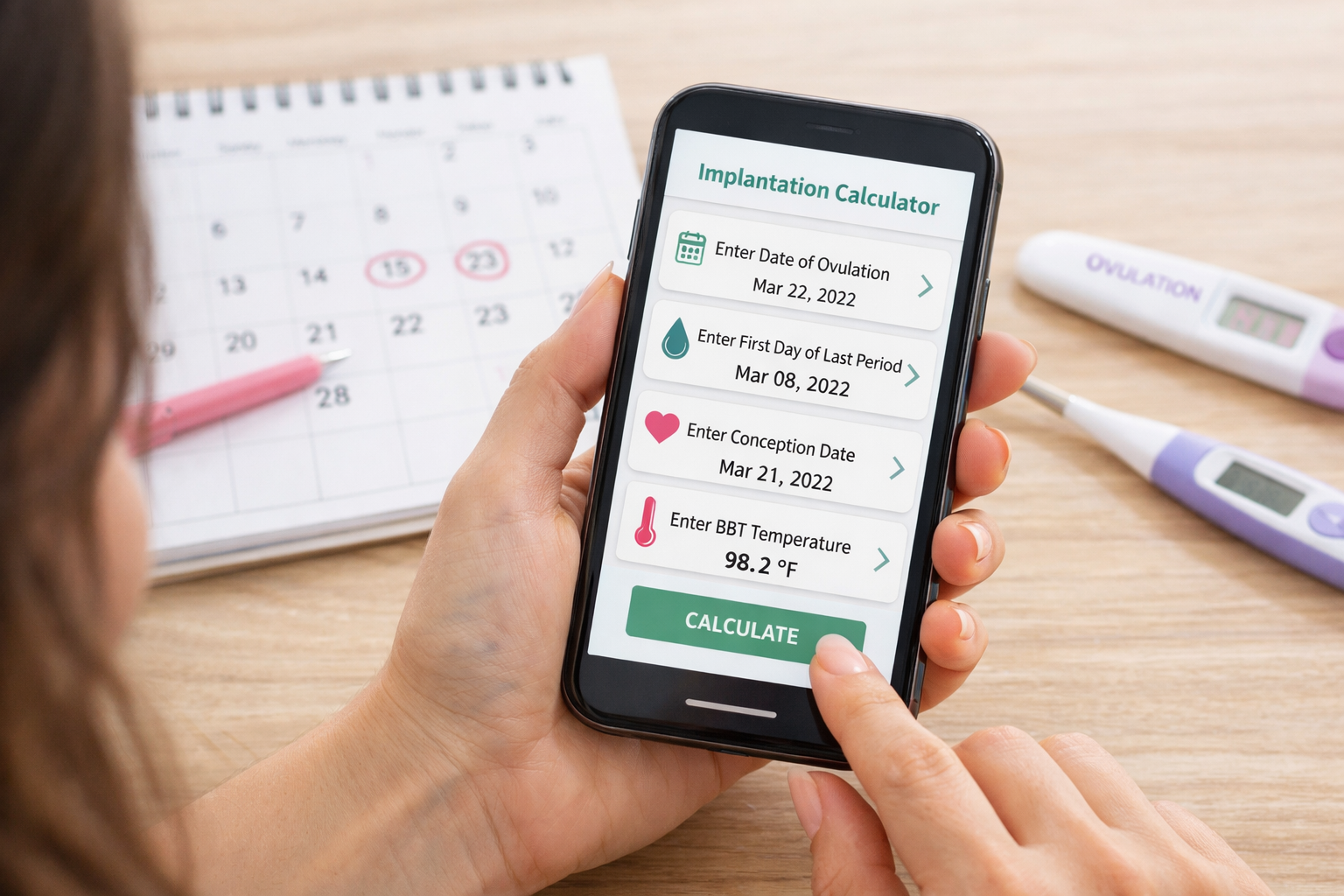
Start by gathering your fertility data. The most common input is the first day of your last menstrual period (LMP). If you have a regular cycle, many calculators can then estimate your ovulation and subsequent dates. However, if your cycles are irregular or you track ovulation, inputting your specific ovulation date will yield much more accurate results. This is because ovulation can vary significantly between individuals and cycles, and directly knowing this date bypasses the need for the calculator to estimate it. Some tools might also ask for your average cycle length to fine-tune calculations. Once you've entered the required data, the calculator will provide an estimated window for when conception occurred and, more importantly, when implantation is most likely to happen. This implantation window is key for understanding early symptoms and optimal pregnancy test timing.
Step-by-Step Guide for Using the Calculator
- Identify Your Input Data:
- Option 1 (Most Common): The first day of your Last Menstrual Period (LMP).
- Option 2 (Most Accurate): Your confirmed ovulation date (e.g., from ovulation predictor kits (OPKs) or basal body temperature (BBT) charting).
- Locate a Reliable Online Calculator: Search for "conception implantation calculator" on reputable fertility websites.
- Enter Your Information: Input your LMP or ovulation date into the designated fields. Some calculators might also ask for your average cycle length.
- Review the Results: The calculator will display:
- Estimated Conception Date
- Estimated Implantation Date (often a window of several days)
- Earliest Date to Take a Pregnancy Test
- Interpret with Context: Remember these are estimates. Your actual dates may vary slightly. Use this information as a guide for monitoring symptoms and planning pregnancy tests.
For instance, if you track your ovulation using an OPK and confirmed ovulation on February 5th, 2026, entering this into the calculator will give you a conception date around February 5th-6th and an implantation window typically between February 11th and February 17th. This allows you to look for implantation symptoms day by day within that specific timeframe and avoid testing too early. If you only provide your LMP, the calculator's estimates will carry a broader margin of error, especially if your cycle length deviates from the 28-day average.
What Factors Influence the Accuracy of a Conception Implantation Calculator?
The accuracy of a conception implantation calculator is primarily influenced by the precision of the input data and the regularity of an individual's menstrual cycle. While these tools offer helpful estimates, their exactness can vary significantly based on biological factors and how well ovulation is pinpointed.
The most critical factor affecting accuracy is the reliability of the ovulation date. If the calculator relies solely on your last menstrual period (LMP) and assumes an average 28-day cycle with ovulation on day 14, its estimates can be off if your cycle is shorter, longer, or irregular. Ovulation can happen earlier or later in a cycle, directly shifting the entire timeline for conception and implantation. For example, late ovulation will naturally delay both conception and implantation. Furthermore, the exact day of implantation, even after successful fertilization, can vary. While the typical window is 6-12 days post-ovulation, some embryos implant earlier or later within that range. A conception implantation calculator provides an average, but individual biological variations mean the actual date might fall on either end of the predicted window.
Factors that Affect Calculator Accuracy
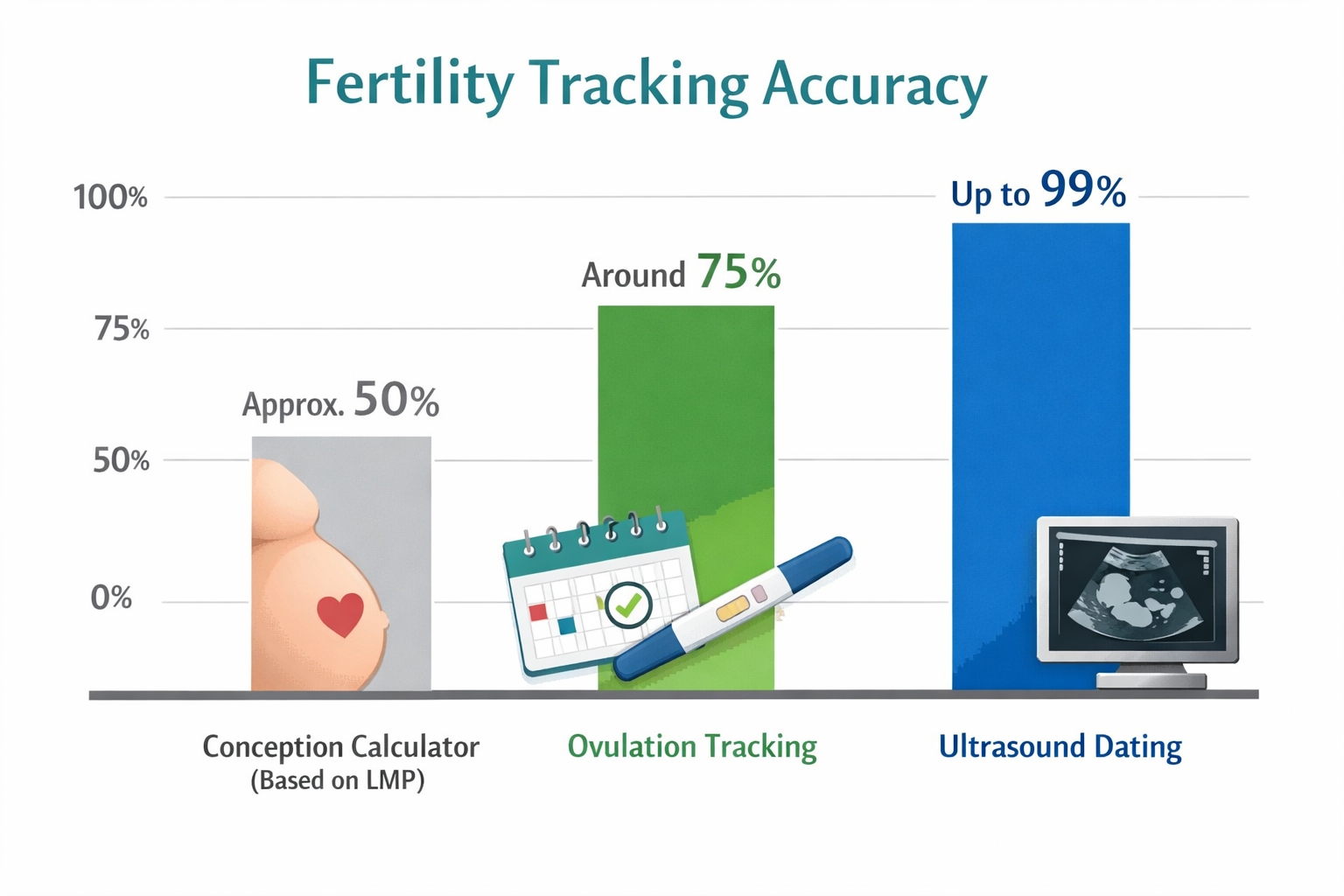
- Menstrual Cycle Length: Irregular cycles or cycles significantly shorter or longer than the average 28 days will lead to inaccurate estimations if only LMP is provided.
- Ovulation Timing: The exact day of ovulation can vary from cycle to cycle, even in individuals with relatively regular periods. Precise ovulation tracking (e.g., with OPKs, BBT charting, or ultrasound) significantly improves accuracy.
- Fertilization Window: While conception typically occurs within 12-24 hours of ovulation, the precise moment is unknown.
- Implantation Variability: The fertilized egg typically implants 6-12 days after ovulation, but the exact day within this window varies per individual and even per pregnancy. Can implantation happen at 12 DPO? Yes, it's at the later end of the normal range.
- External Factors: Stress, illness, medication, and lifestyle changes can subtly affect ovulation and cycle length, subtly impacting the accuracy of past calculations.
For maximum accuracy, using a conception implantation calculator in conjunction with other fertility tracking methods is recommended. For instance, if you use an ovulation predictor kit (OPK) to identify your LH surge or track your basal body temperature (BBT) to confirm ovulation, inputting this precise ovulation date into the calculator will provide a much more tailored and accurate estimate of your conception and implantation window. This combined approach minimizes reliance on generalized averages and accounts for your unique physiological timing. Without accurate ovulation data, any calculator will only offer a general guideline rather than a precise prediction.
Conclusion
Understanding the intricate timeline of conception and implantation is a crucial step for anyone trying to conceive or simply seeking to better understand their body. A conception implantation calculator serves as an invaluable digital tool, providing estimated windows for these pivotal early pregnancy events based on your Last Menstrual Period (LMP) or, more accurately, your ovulation date. While these calculators offer helpful guidance, it's essential to remember they provide estimates based on averages. Individual biological variations mean actual dates can differ.
For the most precise insights, integrate the calculator with proactive fertility tracking methods like ovulation predictor kits (OPKs) or basal body temperature (BBT) charting. This allows you to input exact ovulation data, significantly enhancing the calculator's accuracy for predicting conception and implantation. Knowing your estimated implantation window can help you identify subtle early pregnancy symptoms and determine the optimal time to take a home pregnancy test, minimizing the anxiety of testing too early. Ultimately, while calculators are a fantastic starting point, always consult a healthcare professional for personalized advice and confirmation of pregnancy.
Actionable Next Steps:
- Gather Your Data: Note the first day of your last menstrual period (LMP). If you track ovulation, record that date too.
- Use a Calculator: Visit a reputable website to use a conception implantation calculator to get your estimated dates.
- Track Symptoms: Pay attention to your body around the estimated implantation window for potential early pregnancy symptoms before a missed period.
- Time Your Pregnancy Test: Use the calculator's "earliest test date" as a guide, but wait until after a missed period for the most reliable results.
- Consult a Professional: If you have questions or achieve a positive pregnancy test, schedule an appointment with your healthcare provider for confirmation and guidance.
FAQ
Q1: What is the main purpose of a conception implantation calculator?
A1: The main purpose of a conception implantation calculator is to estimate the likely dates of fertilization (conception) and when the fertilized egg attaches to the uterine wall (implantation), helping individuals understand their early pregnancy timeline.
Q2: What information do I need to use a conception implantation calculator?
A2: You typically need the first day of your last menstrual period (LMP) or, for greater accuracy, your confirmed ovulation date.
Q3: How accurate are these calculators?
A3: Their accuracy depends heavily on the precision of your input data and the regularity of your menstrual cycle. Providing a confirmed ovulation date yields much more accurate results than just an LMP.
Q4: When does conception usually occur relative to ovulation?
A4: Conception typically occurs within 12-24 hours after an egg is released during ovulation.
Q5: When does implantation usually occur after ovulation?
A5: Implantation typically occurs 6 to 12 days after ovulation, with the most common timing being 8-10 days post-ovulation.
Q6: Can a conception implantation calculator tell me the exact day I conceived?
A6: No, it provides an estimate. While conception happens within 12-24 hours of ovulation, pinpointing the exact moment is impossible without continuous observation of the egg and sperm.
Q7: Does the calculator predict pregnancy?
A7: No, it only predicts the potential dates for conception and implantation. It does not confirm pregnancy; only a positive pregnancy test or a doctor can do that.
Q8: What if I have irregular periods?
A8: If you have irregular periods, relying solely on your LMP will yield less accurate results. Using a calculator with a confirmed ovulation date (from OPKs or BBT) is highly recommended.
Q9: When is the best time to take a pregnancy test based on these calculations?
A9: It's generally best to wait until at least the day of your missed period, or a few days after your estimated implantation window, as hCG levels need time to rise to detectable levels.
Q10: Why is knowing the implantation date important?
A10: Knowing the estimated implantation date can help you understand potential early pregnancy symptoms like implantation bleeding or cramping, and it informs the optimal timing for taking a pregnancy test.
Sources
- American College of Obstetricians and Gynecologists (ACOG). (2021). Planning for Pregnancy.
- National Institute of Child Health and Human Development (NICHD). (2020). How does fertilization happen?
Related Reading
- Accurate Conception Calculator – Find Out When You Conceived
- Implantation Calculator (DPO) – When to Test + Implantation Date Calculator
- Fertile Window Calculator: Maximize Conception in 2025
- Implantation Symptoms Day by Day
- Can You Know Exact Day You Conceived? 2026
Meta Title: Conception Implantation Calculator: Your 2026 Guide to Early Pregnancy Meta Description: Estimate your conception and implantation dates with our 2026 conception implantation calculator. Understand early pregnancy signs and when to test.
Tags: conception implantation calculator, implantation date, conception date, ovulation, early pregnancy, fertility, pregnancy test, LMP, DPO, fertility tracking, 2026, pregnancy planning# Decoding Your Early Pregnancy Journey: The Conception Implantation Calculator (2026) Last updated: April 17, 2026
The journey from conception to implantation is a delicate dance of biological events, typically spanning about 6 to 12 days after ovulation. A conception implantation calculator helps individuals estimate the likely window for these crucial events, offering valuable insights into potential early pregnancy signs and optimal timing for pregnancy tests. While providing estimates, these tools utilize key dates like your last menstrual period (LMP) or known ovulation day to map out this critical early phase.
Key Takeaways
- A conception implantation calculator estimates the potential dates for fertilization and subsequent implantation of an embryo into the uterine wall.
- These calculators typically rely on your last menstrual period (LMP) or your ovulation date for their calculations.
- Conception usually occurs within 12-24 hours of ovulation, while implantation occurs 6-12 days after ovulation.
- Knowing your estimated implantation date can help you understand potential early pregnancy symptoms like implantation bleeding or cramping.
- It also guides the optimal timing for taking a home pregnancy test, as hCG levels become detectable after successful implantation.
- While useful, calculators provide estimates; actual dates can vary due to individual cycle variations.
- For the most accurate results, combine calculator use with other fertility tracking methods like ovulation predictor kits (OPKs) or basal body temperature (BBT) charting.
- Consult a healthcare professional for personalized advice and confirmation of pregnancy.
What is a Conception Implantation Calculator and How Does It Work?
A conception implantation calculator is an online tool designed to estimate the dates when conception might have occurred and when the fertilized egg (blastocyst) is likely to implant into the uterine lining. It works by taking your Last Menstrual Period (LMP) or your estimated ovulation date as primary inputs, then applying standard biological timelines for ovulation, fertilization, and implantation.
The process begins by identifying your ovulation date. If you provide your LMP, the calculator estimates ovulation based on an average menstrual cycle length (typically 28 days), assuming ovulation occurs around day 14. If you know your exact ovulation date, the calculator uses this as a more precise starting point. Conception (fertilization) is then estimated to occur within 12-24 hours after ovulation, as the egg has a limited lifespan. Following fertilization, the embryo travels down the fallopian tube to the uterus, a journey that takes several days. Implantation, the crucial step where the embryo attaches to the uterine wall, typically happens 6 to 12 days after ovulation, with the most common window being 8-10 days post-ovulation. Therefore, a calculator adds these standard intervals to your provided date to project the key conception and implantation timelines.
Key Phases Estimated by the Calculator
- Ovulation Date: The day an egg is released from the ovary. This is the starting point for fertilization.
- Conception Date: The day the egg is fertilized by sperm, usually within 12-24 hours post-ovulation. You can get a more precise estimate with our Accurate Conception Calculator.
- Implantation Date: The day the fertilized egg (now a blastocyst) attaches to the uterine wall. This typically occurs 6-12 days after ovulation. For more specific details, consider using an Implantation Calculator (DPO).
- Earliest Pregnancy Test Date: The date when enough hCG hormone might be present in your urine for a home pregnancy test to detect it, usually a few days after successful implantation.
For example, if your last menstrual period (LMP) started on January 1st, 2026, and you have a regular 28-day cycle, the calculator would estimate ovulation around January 14th. Conception would then be around January 14th-15th, and implantation would likely fall between January 20th and January 26th. If you know your ovulation date was precisely January 14th, the implantation window becomes more refined. These estimations are particularly helpful for those actively trying to conceive, providing a structured timeline.
How to Use a Conception Implantation Calculator for Best Results
To use a conception implantation calculator effectively, you need to provide accurate information, typically your last menstrual period (LMP) date or your ovulation date. The more precise your input, the more reliable the calculator's estimations will be for both conception and implantation.
Start by gathering your fertility data. The most common input is the first day of your last menstrual period (LMP). If you have a regular cycle, many calculators can then estimate your ovulation and subsequent dates. However, if your cycles are irregular or you track ovulation, inputting your specific ovulation date will yield much more accurate results. This is because ovulation can vary significantly between individuals and cycles, and directly knowing this date bypasses the need for the calculator to estimate it. Some tools might also ask for your average cycle length to fine-tune calculations. Once you've entered the required data, the calculator will provide an estimated window for when conception occurred and, more importantly, when implantation is most likely to happen. This implantation window is key for understanding early symptoms and optimal pregnancy test timing.
Step-by-Step Guide for Using the Calculator
- Identify Your Input Data:
- Option 1 (Most Common): The first day of your Last Menstrual Period (LMP).
- Option 2 (Most Accurate): Your confirmed ovulation date (e.g., from ovulation predictor kits (OPKs) or basal body temperature (BBT) charting).
- Locate a Reliable Online Calculator: Search for "conception implantation calculator" on reputable fertility websites.
- Enter Your Information: Input your LMP or ovulation date into the designated fields. Some calculators might also ask for your average cycle length.
- Review the Results: The calculator will display:
- Estimated Conception Date
- Estimated Implantation Date (often a window of several days)
- Earliest Date to Take a Pregnancy Test
- Interpret with Context: Remember these are estimates. Your actual dates may vary slightly. Use this information as a guide for monitoring symptoms and planning pregnancy tests.
For instance, if you track your ovulation using an OPK and confirmed ovulation on February 5th, 2026, entering this into the calculator will give you a conception date around February 5th-6th and an implantation window typically between February 11th and February 17th. This allows you to look for implantation symptoms day by day within that specific timeframe and avoid testing too early. If you only provide your LMP, the calculator's estimates will carry a broader margin of error, especially if your cycle length deviates from the 28-day average.
What Factors Influence the Accuracy of a Conception Implantation Calculator?
The accuracy of a conception implantation calculator is primarily influenced by the precision of the input data and the regularity of an individual's menstrual cycle. While these tools offer helpful estimates, their exactness can vary significantly based on biological factors and how well ovulation is pinpointed.
The most critical factor affecting accuracy is the reliability of the ovulation date. If the calculator relies solely on your last menstrual period (LMP) and assumes an average 28-day cycle with ovulation on day 14, its estimates can be off if your cycle is shorter, longer, or irregular. Ovulation can happen earlier or later in a cycle, directly shifting the entire timeline for conception and implantation. For example, late ovulation will naturally delay both conception and implantation. Furthermore, the exact day of implantation, even after successful fertilization, can vary. While the typical window is 6-12 days post-ovulation, some embryos implant earlier or later within that range. A conception implantation calculator provides an average, but individual biological variations mean the actual date might fall on either end of the predicted window.
Factors that Affect Calculator Accuracy
- Menstrual Cycle Length: Irregular cycles or cycles significantly shorter or longer than the average 28 days will lead to inaccurate estimations if only LMP is provided.
- Ovulation Timing: The exact day of ovulation can vary from cycle to cycle, even in individuals with relatively regular periods. Precise ovulation tracking (e.g., with OPKs, BBT charting, or ultrasound) significantly improves accuracy.
- Fertilization Window: While conception typically occurs within 12-24 hours of ovulation, the precise moment is unknown.
- Implantation Variability: The fertilized egg typically implants 6-12 days after ovulation, but the exact day within this window varies per individual and even per pregnancy. Can implantation happen at 12 DPO? Yes, it's at the later end of the normal range.
- External Factors: Stress, illness, medication, and lifestyle changes can subtly affect ovulation and cycle length, subtly impacting the accuracy of past calculations.
For maximum accuracy, using a conception implantation calculator in conjunction with other fertility tracking methods is recommended. For instance, if you use an ovulation predictor kit (OPK) to identify your LH surge or track your basal body temperature (BBT) to confirm ovulation, inputting this precise ovulation date into the calculator will provide a much more tailored and accurate estimate of your conception and implantation window. This combined approach minimizes reliance on generalized averages and accounts for your unique physiological timing. Without accurate ovulation data, any calculator will only offer a general guideline rather than a precise prediction.
Conclusion
Understanding the intricate timeline of conception and implantation is a crucial step for anyone trying to conceive or simply seeking to better understand their body. A conception implantation calculator serves as an invaluable digital tool, providing estimated windows for these pivotal early pregnancy events based on your Last Menstrual Period (LMP) or, more accurately, your ovulation date. While these calculators offer helpful guidance, it's essential to remember they provide estimates based on averages. Individual biological variations mean actual dates can differ.
For the most precise insights, integrate the calculator with proactive fertility tracking methods like ovulation predictor kits (OPKs) or basal body temperature (BBT) charting. This allows you to input exact ovulation data, significantly enhancing the calculator's accuracy for predicting conception and implantation. Knowing your estimated implantation window can help you identify subtle early pregnancy symptoms and determine the optimal time to take a home pregnancy test, minimizing the anxiety of testing too early. Ultimately, while calculators are a fantastic starting point, always consult a healthcare professional for personalized advice and confirmation of pregnancy.
Actionable Next Steps:
- Gather Your Data: Note the first day of your last menstrual period (LMP). If you track ovulation, record that date too.
- Use a Calculator: Visit a reputable website to use a conception implantation calculator to get your estimated dates.
- Track Symptoms: Pay attention to your body around the estimated implantation window for potential early pregnancy symptoms before a missed period.
- Time Your Pregnancy Test: Use the calculator's "earliest test date" as a guide, but wait until after a missed period for the most reliable results.
- Consult a Professional: If you have questions or achieve a positive pregnancy test, schedule an appointment with your healthcare provider for confirmation and guidance.
FAQ
Q1: What is the main purpose of a conception implantation calculator?
A1: The main purpose of a conception implantation calculator is to estimate the likely dates of fertilization (conception) and when the fertilized egg attaches to the uterine wall (implantation), helping individuals understand their early pregnancy timeline.
Q2: What information do I need to use a conception implantation calculator?
A2: You typically need the first day of your last menstrual period (LMP) or, for greater accuracy, your confirmed ovulation date.
Q3: How accurate are these calculators?
A3: Their accuracy depends heavily on the precision of your input data and the regularity of your menstrual cycle. Providing a confirmed ovulation date yields much more accurate results than just an LMP.
Q4: When does conception usually occur relative to ovulation?
A4: Conception typically occurs within 12-24 hours after an egg is released during ovulation.
Q5: When does implantation usually occur after ovulation?
A5: Implantation typically occurs 6 to 12 days after ovulation, with the most common timing being 8-10 days post-ovulation.
Q6: Can a conception implantation calculator tell me the exact day I conceived?
A6: No, it provides an estimate. While conception happens within 12-24 hours of ovulation, pinpointing the exact moment is impossible without continuous observation of the egg and sperm.
Q7: Does the calculator predict pregnancy?
A7: No, it only predicts the potential dates for conception and implantation. It does not confirm pregnancy; only a positive pregnancy test or a doctor can do that.
Q8: What if I have irregular periods?
A8: If you have irregular periods, relying solely on your LMP will yield less accurate results. Using a calculator with a confirmed ovulation date (from OPKs or BBT) is highly recommended.
Q9: When is the best time to take a pregnancy test based on these calculations?
A9: It's generally best to wait until at least the day of your missed period, or a few days after your estimated implantation window, as hCG levels need time to rise to detectable levels.
Q10: Why is knowing the implantation date important?
A10: Knowing the estimated implantation date can help you understand potential early pregnancy symptoms like implantation bleeding or cramping, and it informs the optimal timing for taking a pregnancy test.
Sources
- American College of Obstetricians and Gynecologists (ACOG). (2021). Planning for Pregnancy.
- National Institute of Child Health and Human Development (NICHD). (2020). How does fertilization happen?