
Navigating the journey to parenthood can be both exciting and, at times, perplexing. Many couples find themselves wondering about the optimal time to conceive, often feeling a sense of urgency or confusion about their body's intricate rhythms. If you're looking to maximize your chances of getting pregnant, understanding your fertile window is absolutely paramount. This is where a powerful tool like the Fertile Window Calculator: When You’re Most Likely to Conceive becomes an invaluable ally, helping you pinpoint those crucial days with greater accuracy and confidence.
Key Takeaways
- The fertile window is the 6-day period each cycle where conception is most likely, encompassing the 5 days before ovulation and the day of ovulation itself.
- Sperm can survive inside the female reproductive tract for up to 5 days, while an egg is viable for less than 24 hours after ovulation.
- The last 3 days of the fertile window, particularly the day of ovulation and the day before, are considered the 'peak fertility' period.
- A Fertile Window Calculator: When You’re Most Likely to Conceive uses your menstrual cycle data to estimate these crucial days.
- Combining a calculator with other fertility tracking methods like basal body temperature (BBT), LH tests, and cervical mucus observation significantly improves prediction accuracy.
Understanding the Fertile Window: When You’re Most Likely to Conceive
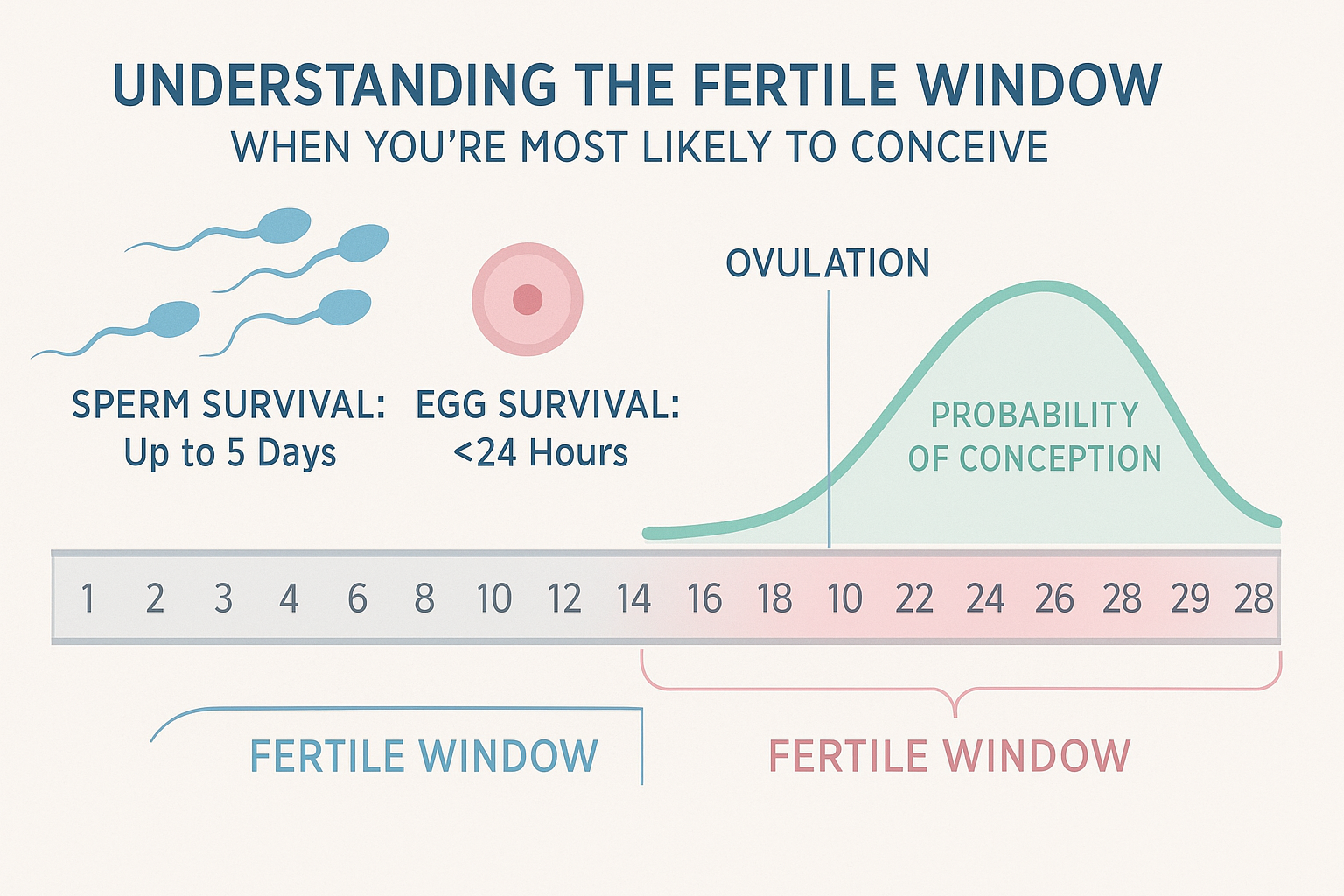
To truly grasp the power of a fertile window calculator, we must first understand the biological processes it aims to track. The fertile window is defined as the 6 days during a woman's menstrual cycle when conception is most likely to occur [1]. This includes the five days leading up to ovulation and the day of ovulation itself. This specific timeframe is crucial because it accounts for the lifespan of both sperm and egg, which are surprisingly different.
Imagine a finely tuned biological clock, where timing is everything. Sperm, once ejaculated, can remain viable and capable of fertilizing an egg inside a woman's body for up to 5 days, and in some cases, even up to 7 days [2]. This remarkable survival period is a key factor in why the fertile window begins before ovulation. It means that intercourse several days before the egg is released can still result in pregnancy, as the sperm will be waiting in the fallopian tubes.
In stark contrast, an egg has a much shorter lifespan. After its release from the ovary (ovulation), an egg survives for less than 24 hours – typically between 12 and 24 hours [3]. This very limited window for fertilization emphasizes the importance of sperm being present and ready when ovulation occurs.
Pinpointing Peak Fertility: The Sweet Spot
Within this 6-day fertile window, not all days carry the same probability of conception. Studies show that the last three days are the most fertile, with sexual intercourse during this period resulting in pregnancy in approximately 30% of cases [4]. The day of ovulation and the day immediately before ovulation represent the 'peak fertility' period, offering the highest chances of conception. This is the ultimate goal when using a Fertile Window Calculator: When You’re Most Likely to Conceive.
Consider this simple breakdown of the fertile window:
- Days 5-3 Before Ovulation: Moderate chance of conception. Sperm are establishing their presence.
- Days 2-1 Before Ovulation (Peak Fertility): High chance of conception. Sperm are ready and waiting as the egg's release is imminent.
- Day of Ovulation (Peak Fertility): Highest chance of conception. The egg is present and ready for fertilization.
- Day After Ovulation: Very low chance of conception, as the egg's viability rapidly diminishes.
Understanding these dynamics is the first step in taking control of your fertility journey. By identifying these peak days, you can strategically time intercourse to significantly boost your odds. For those just starting to track their cycle, an easy-to-use tool like an ovulation calculator can provide initial insights.
"The fertile window is a brief, yet powerful, biological opportunity. Knowing when it opens and closes is like having a roadmap to conception."
The Menstrual Cycle: A Quick Refresher
To appreciate how a fertile window calculator works, it's helpful to remember the basics of the menstrual cycle. An average cycle lasts about 28 days, though variations from 21 to 35 days are common and normal. The cycle is divided into several phases:
- Menstruation (Day 1-7): The shedding of the uterine lining, commonly known as your period. Day 1 is the first day of full flow.
- Follicular Phase (Day 1-14, approximately): Ovarian follicles mature, and the uterine lining thickens in preparation for pregnancy. This phase length can vary significantly.
- Ovulation (Around Day 14 for a 28-day cycle): A mature egg is released from the ovary. This is triggered by a surge in luteinizing hormone (LH).
- Luteal Phase (Day 14-28, approximately): The ruptured follicle transforms into the corpus luteum, producing progesterone to maintain the uterine lining. This phase is typically quite consistent in length, lasting 12-16 days [5].
Ovulation typically occurs about 12 to 16 days before the start of your next period [5]. This is a crucial piece of information for calculators, as the luteal phase (the time from ovulation to your next period) is relatively constant. This means if you know your average cycle length, you can work backward from your expected period date to estimate your ovulation day. For those tracking their cycle length, a cycle length calculator can be very useful.
Using a Fertile Window Calculator: When You’re Most Likely to Conceive with Precision
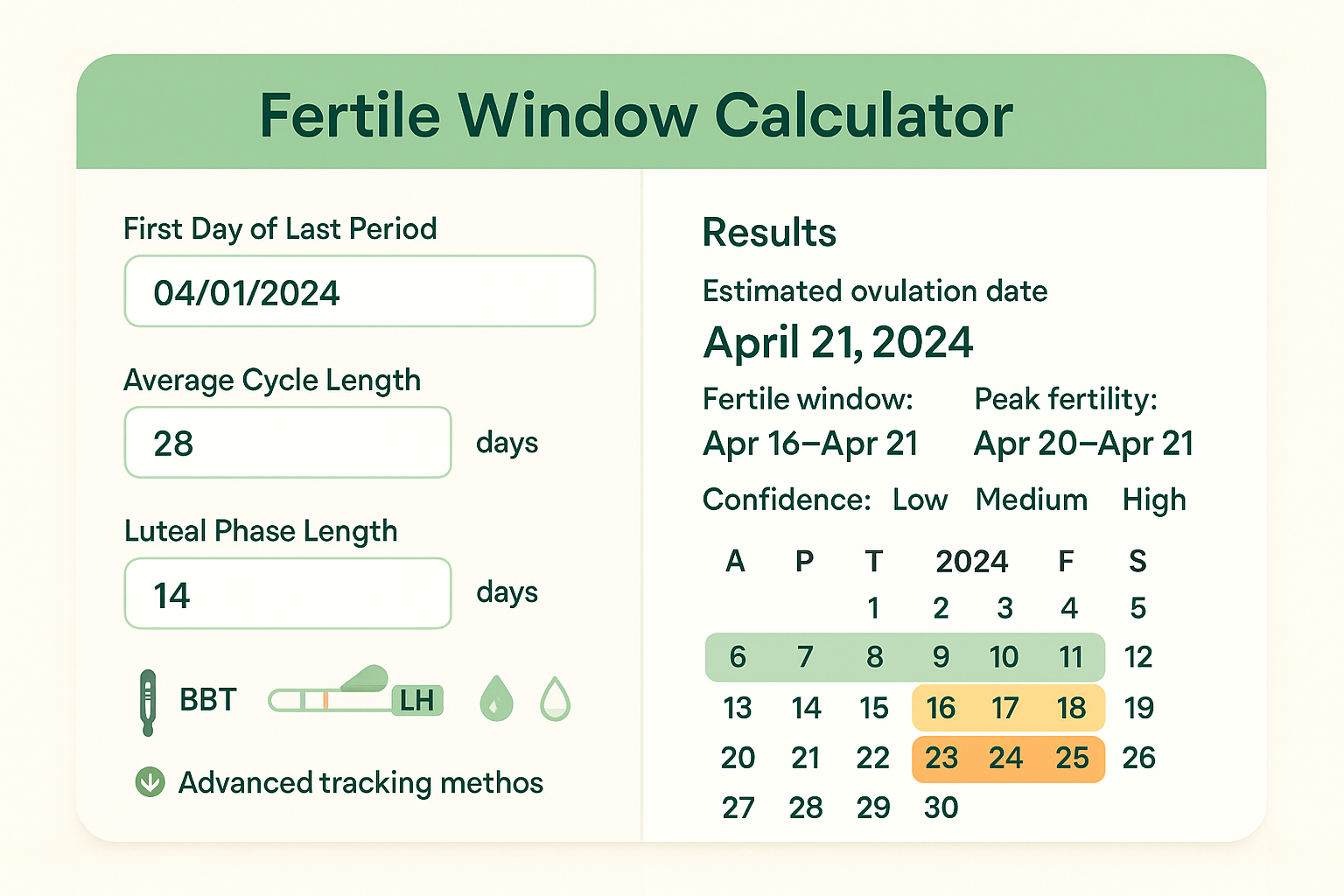
Now that we understand the science, let's explore how a Fertile Window Calculator: When You’re Most Likely to Conceive translates this knowledge into practical predictions. These digital tools are designed to take your individual cycle data and provide an estimated fertile window, helping you plan intercourse more effectively.
The Basic Inputs: Simplicity and Starting Points
At its core, most basic fertile window calculators require just two pieces of information:
- First day of your last menstrual period (LMP): This serves as the starting point for cycle tracking.
- Average cycle length: This is the number of days from the first day of your period to the day before your next period starts.
With just these inputs, the calculator performs a simple calculation. It estimates your ovulation day by subtracting your average luteal phase length (typically 14 days, though some calculators allow customization) from your average cycle length. Once the estimated ovulation day is determined, it then calculates the fertile window by counting back 5 days and including the estimated ovulation day.
For example, if your LMP was January 1, 2025, and your average cycle length is 28 days:
- Your estimated ovulation would be around January 15, 2025.
- Your fertile window would likely be from January 10 to January 15, 2025.
While simple, this method provides a valuable starting point for many individuals.
Advanced Tracking: Boosting Accuracy
For those seeking more precise predictions, advanced fertile window calculators allow for the incorporation of additional fertility tracking data. These tools leverage various biological signals your body provides, creating a more personalized and accurate fertile window prediction.
Here are some key data points that can enhance a calculator's accuracy:
- Basal Body Temperature (BBT): Your BBT is your lowest resting body temperature. After ovulation, there's a slight but sustained rise (0.5-1.0°F or 0.2-0.5°C) in BBT due to the increase in progesterone. By consistently charting your BBT, a calculator can help confirm when ovulation has occurred. A BBT chart tool can be incredibly helpful for visualizing this data.
- Luteinizing Hormone (LH) Test Results: Ovulation predictor kits (OPKs) detect the surge in LH that precedes ovulation. A positive OPK test predicts that ovulation will occur within approximately 24 to 36 hours [6]. This is an excellent way to identify the imminent arrival of your peak fertility window.
- Cervical Mucus Observations: Changes in cervical mucus throughout your cycle can provide strong clues about your fertility. During the fertile window, cervical mucus becomes thinner, clearer, and has a consistency similar to raw egg whites. This "fertile quality" mucus helps sperm travel more easily to the egg and can be used as a natural predictor of ovulation [7].
- Cycle History: Providing data from several past cycles allows the calculator to learn your individual patterns and potentially identify irregularities or variations that a single cycle's data might miss.
By inputting this detailed information, a sophisticated Fertile Window Calculator: When You’re Most Likely to Conceive can offer predictions with varying confidence ratings (Low, Medium, High) based on the amount and consistency of data provided. The more detailed and consistent your inputs, the higher the confidence in the prediction.
Beyond Conception: Pregnancy Dating
The utility of these calculations extends beyond just pinpointing the fertile window. Once conception occurs, the same principles can be used to estimate your due date.
- LMP Method: The most common method adds 280 days (40 weeks) to the first day of your last menstrual period to estimate your due date.
- Conception Date Method: If you know your precise conception date (which a fertile window calculator helps you identify), you can add 266 days (approximately 38 weeks) to this date for a more accurate pregnancy dating [8].
For expectant parents, tools like a due date calculator or a pregnancy week calculator build directly upon the knowledge gained from fertile window tracking.
Who Benefits Most from a Fertile Window Calculator?
A Fertile Window Calculator: When You’re Most Likely to Conceive is a valuable resource for a wide range of individuals:
- Couples Trying to Conceive (TTC): This is the primary audience, aiming to optimize their chances of pregnancy by timing intercourse.
- Individuals Tracking Cycle Health: Even if not actively trying to conceive, understanding your cycle can be empowering for overall health awareness.
- Those Avoiding Pregnancy (Natural Family Planning): While not a contraceptive, understanding the fertile window is foundational for natural family planning methods.
- Couples Experiencing Delays in Conception: Pinpointing the fertile window can rule out timing issues as a factor and help identify when further medical consultation might be beneficial. Knowing your estimated chance of getting pregnant can be tracked with a pregnancy chance calculator.
Using these tools empowers you with knowledge, turning the often-mysterious process of conception into something more predictable and manageable.
Practical Tips for Using Your Calculator
To get the most out of your fertile window calculator, consider these practical tips:
- Be Consistent: Record your data diligently and accurately, especially the first day of your period and any other fertility signs.
- Track Multiple Cycles: The more cycle data you input, the more accurate your calculator's predictions will become over time.
- Combine Methods: Don't rely solely on the calculator. Use it in conjunction with OPKs, BBT tracking, and cervical mucus observation for the most precise results. You can even use an AI ovulation predictor for advanced insights.
- Understand Its Limitations: Calculators provide estimates. They cannot account for every biological variability or sudden changes in your cycle. Stress, illness, travel, or certain medications can temporarily alter your ovulation day.
- Listen to Your Body: Pay attention to your body's unique signals. While a calculator is a guide, your body often provides its own subtle clues. If you notice unusual ovulation symptoms, consider those as well.
- Seek Professional Advice: If you have consistently irregular cycles, concerns about your fertility, or have been trying to conceive for an extended period (e.g., 12 months for women under 35, 6 months for women over 35), consult with a healthcare provider.
Using a fertility calculator is an ongoing process of learning and refinement. It's a tool to support you, not replace the invaluable insights your body provides or the guidance of medical professionals.
Conclusion
The journey to conception is a deeply personal and often emotional experience. While there's no magic formula, understanding your body's fertile window is undoubtedly one of the most powerful steps you can take to increase your chances of getting pregnant. A Fertile Window Calculator: When You’re Most Likely to Conceive serves as an indispensable guide, transforming complex biological rhythms into actionable insights.
By accurately identifying your most fertile days – the critical 6-day period including the 5 days before and the day of ovulation – you can optimize the timing of intercourse, significantly enhancing your prospects of conception in 2025. Whether you're just starting to track your cycle or have been trying for a while, integrating a calculator with other fertility awareness methods like BBT charting, LH tests, and cervical mucus observation will provide the most precise predictions.
Empower yourself with knowledge, utilize the advanced tools available, and approach your fertility journey with confidence and clarity. Remember, consistency in tracking and a holistic understanding of your body are key to unlocking your highest chances of conception.
Actionable Next Steps:
- Start Tracking Today: Begin recording the first day of your period and your average cycle length.
- Utilize a Calculator: Find a reliable fertile window calculator online and input your data.
- Consider Advanced Methods: Explore adding BBT tracking, OPKs, or cervical mucus observation for greater accuracy.
- Be Patient and Consistent: Fertility journeys can take time. Stay consistent with your tracking and remain positive.
- Consult a Professional: If you have concerns about your cycle or conception, don't hesitate to speak with your doctor.
References:
[1] Wilcox, A. J., Weinberg, C. R., & Baird, D. D. (1995). Timing of sexual intercourse in relation to ovulation. New England Journal of Medicine, 333(23), 1517-1521.
[2] Setchell, B. P. (1970). The survival of spermatozoa in the female reproductive tract. The Journal of Reproduction and Fertility, 21(3), 579-583.
[3] Barratt, C. L. R., Bjorndahl, L., De Jonge, C. J., EFORTT, F. F., Lambrecht, S., Mbizvo, M. T., ... & WHO Laboratory Manual Revision Group. (2017). The decline in sperm quality in humans due to environmental factors. Human Reproduction Update, 23(3), 263-277.
[4] Stanford, J. B., White, G. L., & Hatasaka, H. H. (2002). Timing of intercourse to achieve pregnancy: current evidence. Obstetrics & Gynecology, 100(6), 1333-1340.
[5] Lenton, E. A., Landgren, B. M., & Sexton, L. (1984). Normal variation in the length of the luteal phase of the menstrual cycle. British Journal of Obstetrics and Gynaecology, 91(7), 683-688.
[6] Blackwell, L. F., & Cooke, I. (1994). The pre-ovulatory luteinizing hormone surge and its relationship to ovulation, follicular rupture and subsequent corpus luteum development. Human Reproduction, 9(3), 398-403.
[7] Hilgers, T. W. (2010). The NaProTechnology Revolution: Unleashing the Power of a Woman's Cycle. Pope Paul VI Institute Press.
[8] American College of Obstetricians and Gynecologists. (2017). Methods for Estimating the Due Date. Committee Opinion No. 700.