Quick Answer: To calculate your conception date from a due date, subtract 266 days (38 weeks) from your due date. This gives you the approximate date of fertilization. Because most due dates are set using a 280-day (40-week) pregnancy from the last menstrual period (LMP), you can also subtract 14 days from that LMP-based start point to account for ovulation timing. Keep in mind this is an estimate — cycle length and ovulation timing affect accuracy.
Key Takeaways
- The core formula: Conception date = Due date minus 266 days (38 weeks).
- A standard pregnancy is 280 days from LMP, but conception happens roughly 14 days after LMP (at ovulation), making the actual conception-to-birth window about 266 days.
- Due dates are estimates, not guarantees — only about 4% of babies are born on their exact due date (American College of Obstetricians and Gynecologists).
- Irregular cycles shift ovulation, which shifts the conception window — sometimes by a week or more.
- Ultrasound dating (especially before 12 weeks) is the most accurate clinical method for estimating conception timing.
- Online conception calculators can automate this math quickly and reliably.
- Knowing your conception date can help with paternity questions, prenatal planning, and understanding your pregnancy timeline.
- The conception date is not the same as the ovulation date — though they're often very close.
Why Calculating Conception Date From Due Date Matters
Knowing when conception likely occurred matters for more reasons than curiosity. For many people, pinpointing the conception date helps clarify paternity, understand fetal development milestones, or simply satisfy the very human need to know when a new life began.
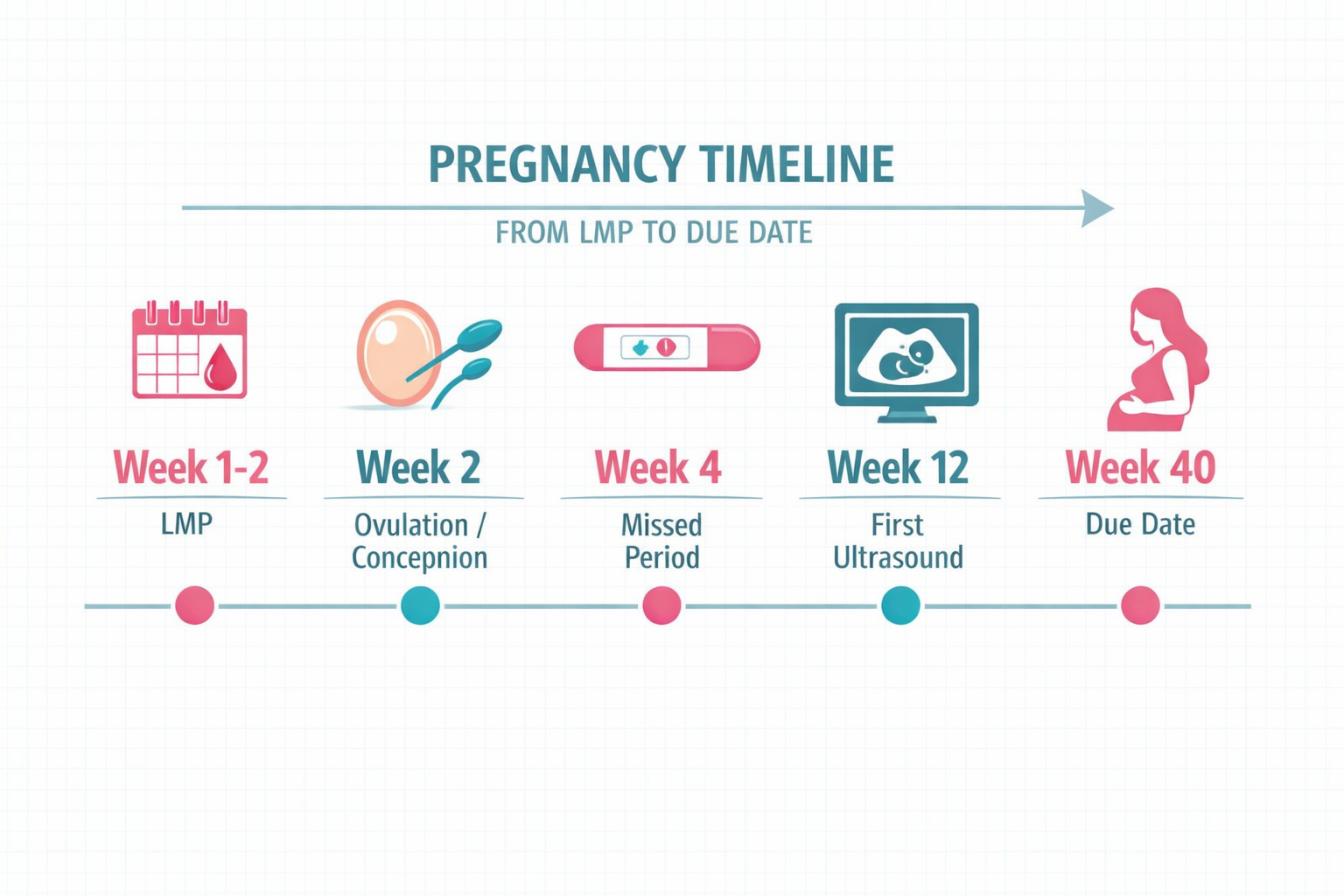
The good news: the math is straightforward once you understand how pregnancy dating works. Doctors measure pregnancy from the first day of the last menstrual period (LMP), not from conception itself. That's a two-week head start built into every due date calculation.
How Does Standard Pregnancy Dating Work?
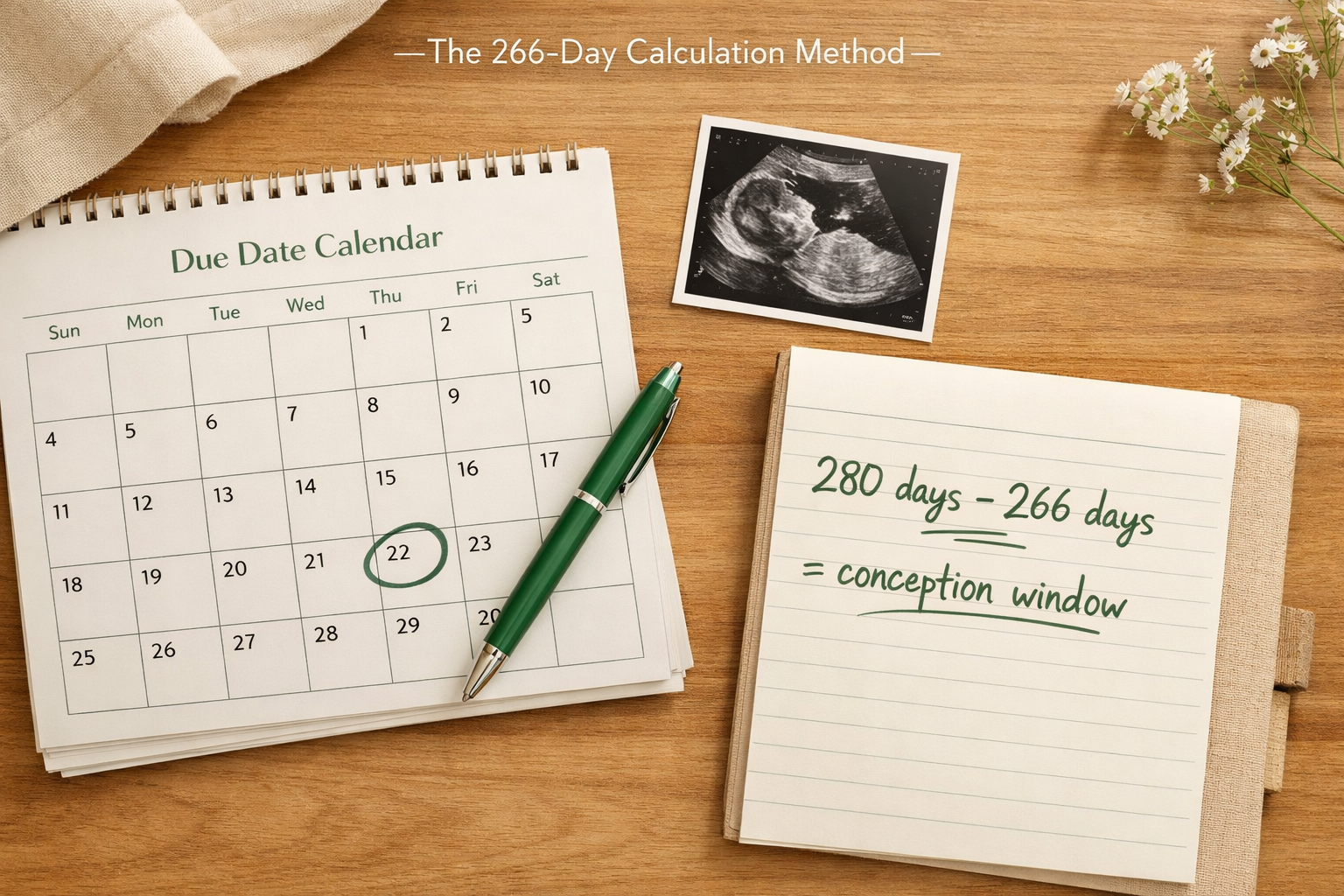
Pregnancy is conventionally measured as 280 days (40 weeks) from the first day of the LMP. This standard, established by Franz Karl Naegele in the 19th century and still used today, assumes a 28-day cycle with ovulation on Day 14.
Here's the key distinction: conception doesn't happen on Day 1 of your cycle. It happens around Day 14, when ovulation occurs. So when a due date is calculated from LMP, the first two weeks of "pregnancy" technically predate fertilization.
This is why the conception-to-birth window is approximately 266 days (38 weeks), not 280.
The Step-by-Step Formula: Conception Date From Due Date — How to Calculate It Accurately
Calculating your conception date from a due date is a simple subtraction problem. Here's how to do it:
Step 1: Start with your confirmed due date (from your doctor or ultrasound report).
Step 2: Subtract 266 days (38 weeks) from that date.
Step 3: The resulting date is your estimated conception date.
Example:
- Due date: January 15, 2027
- Subtract 266 days → Conception date: approximately April 24, 2026
You can also work backward from LMP:
Alternate method:
- Take your LMP date.
- Add 14 days to estimate ovulation (and therefore conception).
- This should align closely with the result of the first method.
For a quick, automated version of this calculation, try our Accurate Conception Calculator or the When Did I Conceive Calculator.
Quick rule: Due date minus 266 days = estimated conception date. It's that simple — but cycle irregularity can shift this window.
What Affects the Accuracy of Your Conception Date Estimate?
The formula above works well for women with regular 28-day cycles. But several factors can shift the actual conception date by days or even weeks.
Factors that affect accuracy:
- Cycle length: If your cycle is 35 days instead of 28, ovulation likely happens around Day 21, not Day 14. This pushes the conception date later than the formula suggests. See our guide on late ovulation and fertility for more context.
- Irregular cycles: Ovulation can vary month to month, making it harder to pin down a single conception date.
- Sperm survival: Sperm can live inside the reproductive tract for up to 5 days (Mayo Clinic). So conception may occur 1–5 days after intercourse, not necessarily on the day of sex itself.
- Due date accuracy: If your due date was set by LMP alone (without ultrasound confirmation), it may already carry a margin of error of 1–2 weeks.
- Early ultrasound: A first-trimester ultrasound (before 12 weeks) is considered the gold standard for dating a pregnancy. It can refine your due date and, by extension, your estimated conception date. Learn more about how ultrasound estimates conception date.
Choose this method if: Your cycles are regular and close to 28 days. The formula will be quite reliable.
Be cautious if: You have irregular cycles, recently stopped hormonal contraception, or your due date was set without an early ultrasound.
Regular vs. Irregular Cycles: How Ovulation Timing Changes Everything
For women with cycles shorter or longer than 28 days, the standard 14-day ovulation assumption breaks down. This is one of the most common sources of confusion when calculating conception date from due date.
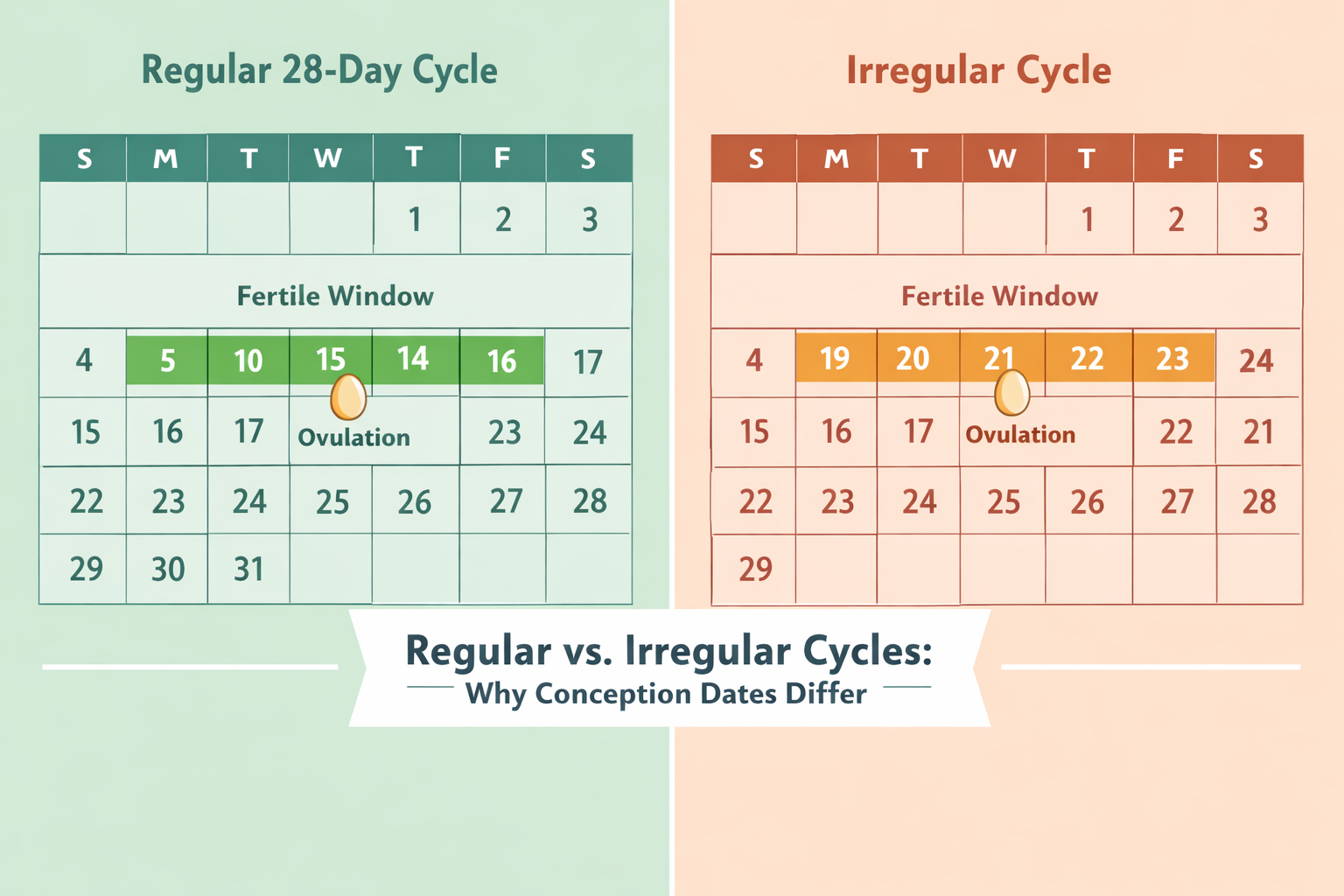
| Cycle Length | Estimated Ovulation Day | Adjustment to Formula |
|---|---|---|
| 21 days | Day 7 | Subtract 7 extra days from standard estimate |
| 28 days | Day 14 | No adjustment needed |
| 35 days | Day 21 | Add 7 days to standard estimate |
| 40 days | Day 26 | Add 12 days to standard estimate |
Common mistake: Assuming ovulation always happens on Day 14. For someone with a 35-day cycle, this error shifts the estimated conception date by a full week. Understanding the difference between conception date vs. ovulation date can help you avoid this mistake.
If you're unsure about your cycle length, our cycle length calculator can help you find your average.
How Accurate Is a Conception Date Calculated From a Due Date?
The honest answer: it's a solid estimate, not a precise fact. The conception date calculated from a due date carries an inherent margin of error of roughly 3–5 days for women with regular cycles, and potentially 1–2 weeks for those with irregular cycles or uncertain due dates.
For a deeper look at accuracy ranges and what affects them, see our detailed guide on conception date accuracy from due date.
What improves accuracy:
- A due date confirmed by early ultrasound (before 12 weeks)
- Known, regular cycle length
- Documented ovulation tracking (BBT, LH strips)
What reduces accuracy:
- Due date based only on LMP recall
- Irregular or unknown cycle length
- Recent hormonal contraceptive use
For most practical purposes — understanding your pregnancy timeline, tracking fetal development with a week-by-week pregnancy calendar, or satisfying curiosity — the formula is more than adequate. For legal or medical purposes, consult a healthcare provider and request ultrasound-based dating.
FAQ
Q: Can I calculate my conception date if I don't know my LMP? Yes. Start with your due date and subtract 266 days. You don't need your LMP date for this calculation — the due date is enough.
Q: Is the conception date the same as the ovulation date? Not exactly. Conception (fertilization) typically occurs within 12–24 hours of ovulation. They're usually within a day of each other, but not always the same date. See conception date vs. ovulation date for a full explanation.
Q: What if my due date changed after an ultrasound? Use the ultrasound-adjusted due date for your calculation. It's more accurate than an LMP-based due date, especially if there's a discrepancy of more than 5–7 days.
Q: Can I use this formula to determine paternity? The formula gives a conception window, not an exact date. Sperm can survive up to 5 days, so the fertile window spans several days. For definitive paternity determination, DNA testing is required.
Q: How do I know if my due date is accurate enough to trust this calculation? If your due date was set by a first-trimester ultrasound, it's quite reliable. If it was set only by LMP, there may be a margin of error of 1–2 weeks.
Q: Does the formula work for IVF pregnancies? No. IVF pregnancies are dated differently because the transfer date and embryo age are known precisely. Your fertility clinic will give you an accurate conception date directly.
Q: What is the earliest I could have conceived given a due date? Subtract 280 days from your due date to get the LMP date. Conception is unlikely before Day 10 of that cycle, so add 10 days to the LMP date for the earliest plausible conception.
Q: Can I find out the exact day I conceived? Rarely, without documented ovulation tracking. For more on this, read can you know the exact day you conceived.
Conclusion: Your Next Steps
Calculating your conception date from a due date comes down to one reliable formula: due date minus 266 days. For most people with regular cycles and an ultrasound-confirmed due date, this estimate will land within a few days of the actual conception date.
Here's what to do next:
- Confirm your due date — ideally with a first-trimester ultrasound report.
- Apply the formula — subtract 266 days, or use our conception calculator to do it instantly.
- Adjust for cycle length — if your cycle isn't 28 days, use the table above to refine your estimate.
- Track your pregnancy timeline — once you have your conception date, use a week-by-week pregnancy calendar to follow fetal development.
- Consult a provider for any medical or legal questions — an OB or midwife can provide clinical dating with ultrasound precision.
The math is simple. The biology is a little messier. But with the right tools and a clear understanding of how pregnancy dating works, you can get a reliable answer.
References
- American College of Obstetricians and Gynecologists. (2017). Methods for Estimating the Due Date. Committee Opinion No. 700. https://www.acog.org/clinical/clinical-guidance/committee-opinion/articles/2017/05/methods-for-estimating-the-due-date
- Mayo Clinic. (2022). Getting pregnant: How long does it take? https://www.mayoclinic.org/healthy-lifestyle/getting-pregnant/expert-answers/how-to-get-pregnant/faq-20058287
- Naegele, F.K. (1812). Erfahrungen und Abhandlungen aus dem Gebiete der Krankheiten des weiblichen Geschlechtes. (Historical basis for Naegele's Rule.)
- Hadlock, F.P., et al. (1992). Estimation of fetal age: computer-assisted analysis of multiple fetal growth parameters. Radiology. https://doi.org/10.1148/radiology.152.2.6741947