Quick Answer: Yes, your workout routine can affect ovulation and your fertile window. Moderate exercise generally supports hormonal balance and healthy cycles, while excessive high-intensity training can delay or suppress ovulation by elevating cortisol and disrupting the hormonal signals that trigger egg release. The key is intensity, frequency, and body composition, not exercise itself.
Key Takeaways
- Moderate exercise (150 minutes per week of moderate activity) supports reproductive hormone balance and regular ovulation.
- Overtraining or chronic high-intensity exercise can suppress ovulation by disrupting the hypothalamic-pituitary-ovarian (HPO) axis.
- Elevated cortisol from intense workouts signals the brain to reduce reproductive hormone output, which can delay or skip ovulation.
- Very low body fat from extreme exercise can cause estrogen to drop low enough to stop ovulation entirely.
- Running, cycling, and cardio are not inherently harmful to fertility, but volume and recovery matter significantly.
- During your fertile window, low-to-moderate exercise is generally safe and may even improve circulation and mood.
- Rest days are not optional when trying to conceive; they allow the HPO axis to reset and hormones to stabilize.
- If your period becomes irregular after increasing training intensity, that is a direct sign your cycle may be affected.
- Tracking ovulation with LH strips or basal body temperature can help you spot exercise-related disruptions early.
- Women trying to conceive should discuss significant training loads with a reproductive endocrinologist or OB-GYN.
Does Exercise Affect Ovulation Timing?
Exercise does affect ovulation timing, and the direction of that effect depends almost entirely on how much and how hard you train. Moderate physical activity tends to support regular cycles, while high training loads can push ovulation later in the cycle or suppress it altogether.
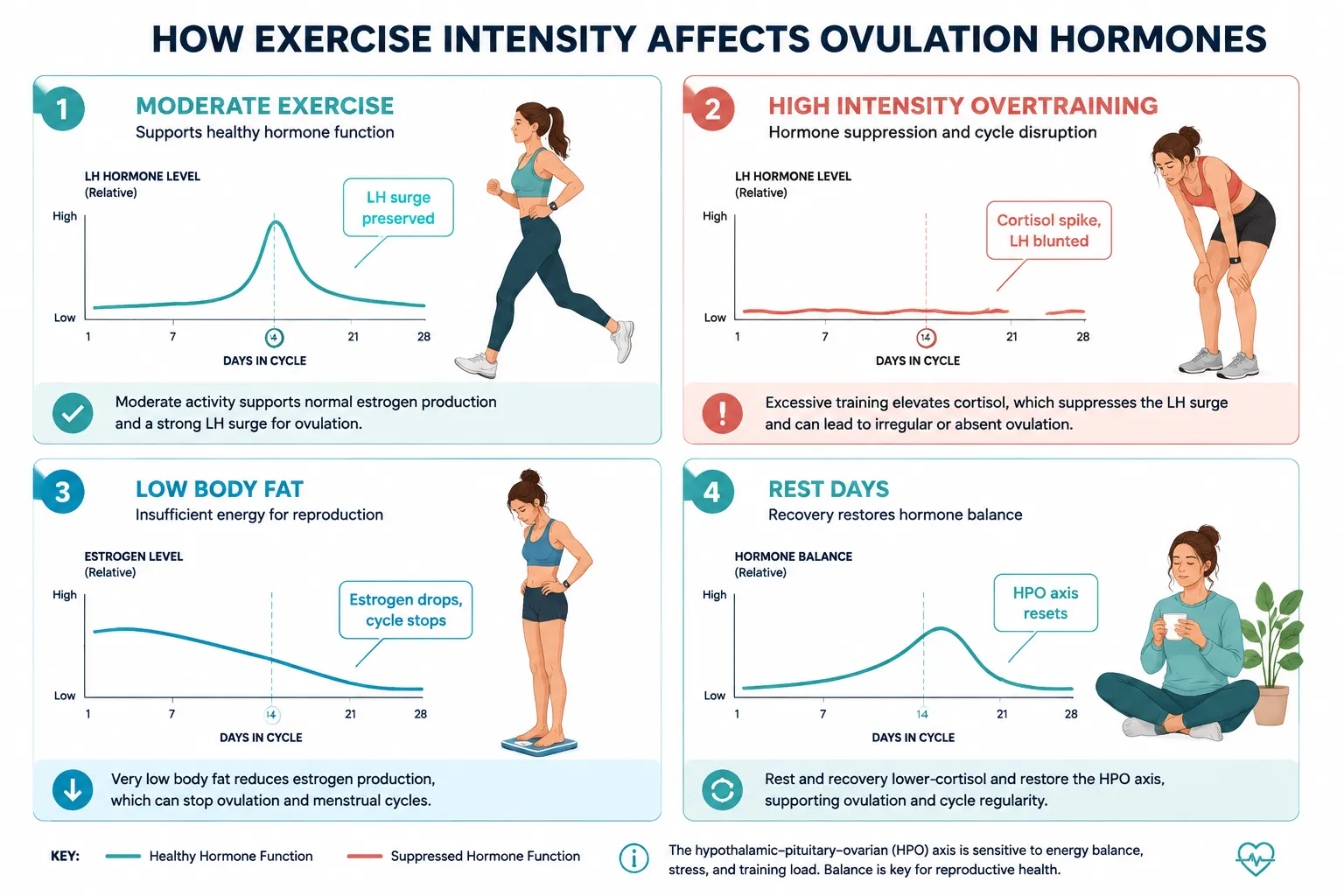
The mechanism is hormonal. Ovulation is triggered by a surge in luteinizing hormone (LH), which is regulated by the hypothalamus and pituitary gland. When the body is under physical stress from overtraining, the hypothalamus reduces its output of gonadotropin-releasing hormone (GnRH), which in turn blunts the LH surge needed for ovulation. A 2002 study published in the Journal of Clinical Endocrinology and Metabolism found that women who exercised at high intensities showed measurable disruptions in LH pulsatility compared to sedentary controls (De Souza et al., 2002).
Bottom line: Light to moderate exercise rarely shifts ovulation timing. Sustained high-intensity training, especially without adequate recovery, can delay it by several days or prevent it entirely in a given cycle.
Can Intense Workouts Delay Your Period?
Yes, intense workouts can delay your period, and this is one of the more common complaints among athletes and women who ramp up their training suddenly. A delayed period is usually a downstream effect of delayed or absent ovulation, since menstruation follows ovulation by roughly 12 to 14 days.
When ovulation is pushed back by physical stress, your period follows suit. In more severe cases, a condition called exercise-induced amenorrhea can develop, where periods stop for three or more consecutive months. This is most common in endurance athletes, competitive gymnasts, and women who combine heavy training with significant caloric restriction.
Common signs your training may be delaying your cycle:
- Cycles suddenly longer than 35 days after increasing workout frequency
- Spotting instead of a full period
- Basal body temperature charts that never show a clear thermal shift
- Negative ovulation tests despite being mid-cycle
How Does Cortisol from Exercise Affect Ovulation?
Cortisol is the primary stress hormone, and it is the main biological bridge between hard workouts and disrupted ovulation. When you exercise intensely, cortisol rises as part of a normal acute stress response. The problem arises when training volume is high enough that cortisol stays chronically elevated between sessions.
High cortisol suppresses GnRH from the hypothalamus, which reduces FSH and LH output from the pituitary. Without adequate LH, the follicle in your ovary does not receive the signal to release an egg. Research published in Fertility and Sterility has linked chronically elevated cortisol in athletes to luteal phase defects and anovulatory cycles (Loucks & Thuma, 2003).
Practical implication: If you are training hard and tracking ovulation, watch for a shortened luteal phase (fewer than 10 days between ovulation and your period) as an early warning sign that cortisol may be interfering with your cycle.
Does Running or Cardio Mess with Fertility?
Running and cardio do not inherently harm fertility. Moderate cardio, defined as roughly 30 to 45 minutes most days at a conversational pace, is associated with healthy hormonal profiles and regular cycles in most research. The problem is not the type of exercise but the total stress load.
Where runners and cyclists run into trouble is when weekly mileage climbs sharply, caloric intake does not keep pace, or rest is inadequate. A woman running 50-plus miles per week while eating in a caloric deficit is in a very different physiological situation than one running 20 miles per week with good nutrition and sleep.
Choose moderate cardio if: You are trying to conceive and want to maintain fitness without disrupting your cycle. Reassess your cardio if: Your cycles have become irregular since increasing mileage, or you are losing weight unintentionally while training.
How Much Exercise Is Too Much When Trying to Get Pregnant?
There is no single number that applies to every woman, but research and clinical guidance offer useful thresholds. The American College of Obstetricians and Gynecologists (ACOG) recommends 150 minutes of moderate-intensity aerobic activity per week for most healthy adults, including those trying to conceive. Going significantly beyond this threshold, particularly with high-intensity work, is where reproductive risk increases.
Signs you may be overtraining relative to your fertility goals:
- Irregular or absent periods
- Persistent fatigue that does not resolve with sleep
- Frequent illness or slow injury recovery
- Loss of menstrual cycle predictability after tracking for 3-plus months
- LH surge that disappears or never appears on ovulation strips
What counts as excessive exercise for fertility purposes: Consistently training more than 60 minutes per day at high intensity, especially combined with low caloric intake or significant weight loss, is the pattern most associated with ovulatory disruption in the literature.
Can Low Body Fat from Exercise Stop Ovulation?
Yes, very low body fat can stop ovulation entirely. Fat tissue plays a direct role in estrogen production through a process called peripheral aromatization, where androgens are converted to estrogen in adipose tissue. When body fat drops too low, estrogen production falls, and the hormonal environment needed for follicle development and ovulation collapses.
The threshold varies by individual, but body fat percentages below approximately 17 to 22 percent are associated with menstrual irregularities in some research, though this range is not a hard cutoff for every woman (Frisch & McArthur, 1974, updated in subsequent reviews). Women with very lean physiques from competitive sports or extreme dieting often experience what is now called Relative Energy Deficiency in Sport (RED-S), a condition where the body prioritizes survival over reproduction.
Does Overtraining Suppress Ovulation?
Overtraining suppresses ovulation through the same HPO axis disruption described above, but the effect is more severe and longer-lasting than a single hard week of training. Overtraining syndrome, a clinical state of accumulated physiological stress, can cause months of anovulatory cycles.
The distinction between "training hard" and "overtraining" matters here. Overtraining is characterized by performance decline despite continued training, persistent fatigue, mood disturbances, and hormonal dysregulation. If you are experiencing these symptoms alongside irregular cycles, the solution is not a minor adjustment but a meaningful reduction in training load and a conversation with your doctor.
What Is the Best Time to Exercise During Your Cycle, and What Workouts Are Safe During the Fertile Window?
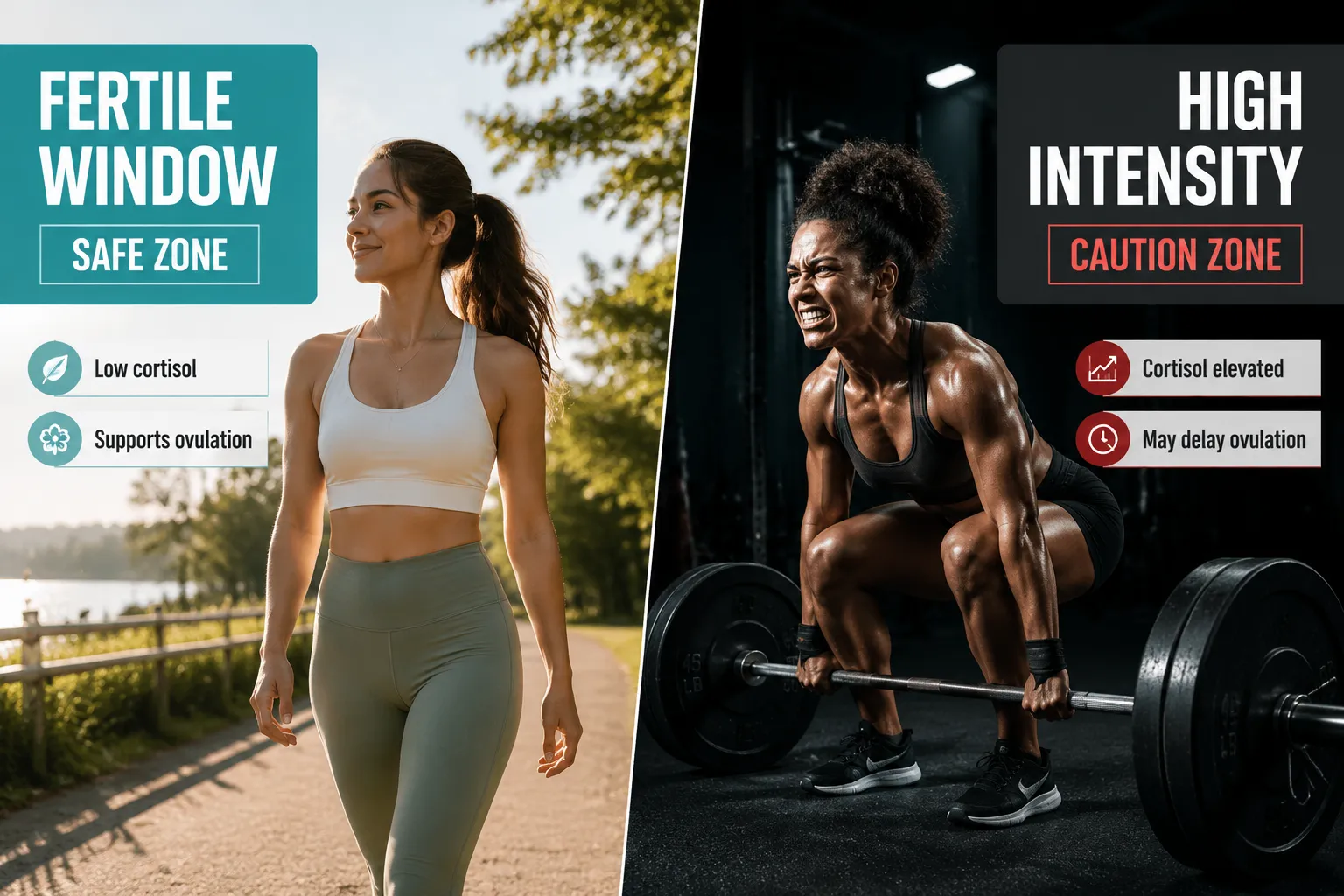
You can exercise during your fertile window, and for most women doing moderate activity, there is no reason to stop or significantly change their routine. The fertile window spans roughly five to six days ending on ovulation day, and light to moderate movement during this time is safe and may support circulation and stress reduction.
Workout recommendations by cycle phase:
| Cycle Phase | What Your Body Is Doing | Recommended Exercise Intensity |
|---|---|---|
| Menstruation (Days 1-5) | Hormone levels low, energy may be lower | Light yoga, walking, gentle stretching |
| Follicular (Days 6-13) | Estrogen rising, energy increasing | Moderate cardio, strength training, cycling |
| Ovulation / Fertile Window (Days 12-17) | LH surge, peak energy | Moderate exercise fine; avoid sudden extreme intensity |
| Luteal (Days 18-28) | Progesterone dominant, fatigue possible | Moderate to light; prioritize recovery |
Is it bad to do high-intensity workouts right before ovulation? A single hard workout before ovulation is unlikely to delay it in a healthy, well-nourished woman. The risk comes from chronic patterns, not isolated sessions. That said, if you are already tracking a delayed LH surge or have a history of irregular cycles, adding a very intense session in the days before expected ovulation is not ideal timing.
Should You Change Your Workout Routine If You Are Tracking Ovulation?
If your cycles are regular and ovulation is occurring predictably, you likely do not need to change anything. But if you are actively trying to conceive and your tracking data shows irregular or absent LH surges, reviewing your training load is a reasonable first step.
Practical adjustments to consider:
- Reduce high-intensity sessions to two or fewer per week while trying to conceive
- Ensure caloric intake matches your training output, especially protein and healthy fats
- Add at least one to two full rest days per week
- Use basal body temperature tracking alongside LH strips to confirm ovulation is occurring
- If cycles remain irregular after six to eight weeks of reduced training, consult a reproductive specialist
For deeper guidance on building a fitness routine that supports your health goals, FitNova360 offers evidence-informed workout programming designed around women's hormonal health.
Do Rest Days Help Regulate Ovulation?
Rest days directly support ovulation by giving the HPO axis time to normalize cortisol and resume regular hormone pulsatility. When training is continuous without adequate recovery, cortisol does not return to baseline, and the suppressive effect on GnRH continues uninterrupted.
Strategic rest is not a sign of reduced commitment to fitness; it is how the body consolidates training adaptations and maintains hormonal health simultaneously. For women trying to conceive, two to three rest or active recovery days per week is a reasonable minimum, particularly during high-volume training blocks.
Conclusion
The relationship between exercise and ovulation is real, measurable, and manageable. Moderate, consistent physical activity supports hormonal balance and regular cycles. The problems arise at the extremes: chronic overtraining, very low body fat, inadequate caloric intake, and insufficient recovery.
Actionable next steps:
- Track your cycle for at least two to three months using LH strips and basal body temperature to establish your baseline.
- Audit your weekly training load. If you are consistently above 60 minutes of high-intensity work per day, consider scaling back.
- Ensure your caloric intake supports your activity level, with adequate fat and protein to support hormone production.
- Add two to three rest or light-activity days per week as a non-negotiable part of your program.
- If your cycles remain irregular despite adjustments, speak with a reproductive endocrinologist or OB-GYN.
For women who want to stay fit while supporting their reproductive health, the goal is not to stop exercising but to exercise smartly. Resources like FitNova360 can help you find that balance with cycle-aware training guidance. And if you are ever uncertain whether your current routine is affecting your fertile window, tracking your data and working with a qualified clinician is always the right call.
For more guidance on building a fitness routine that supports your health goals, FitNova360 offers evidence-informed workout programs focused on fitness and nutrition.
Frequently Asked Questions
Can I exercise every day while trying to get pregnant? Yes, but intensity and recovery matter more than frequency. Daily light to moderate activity is generally fine. Daily high-intensity training without rest days increases the risk of hormonal disruption.
How quickly can overtraining affect my cycle? Some women notice cycle changes within one to two months of significantly increasing training intensity. Others may train hard for years before disruption occurs. Individual response varies based on body composition, nutrition, and stress load.
Does strength training affect ovulation differently than cardio? Not significantly, as long as volume and recovery are comparable. The key variable is total physiological stress, not the modality. Heavy powerlifting five days a week without adequate recovery carries similar risks to high-volume running.
Can I use exercise to improve my chances of ovulating? Yes, for women who are sedentary or overweight, adding moderate exercise can improve insulin sensitivity and hormonal balance, which supports more regular ovulation. A 2020 review in Human Reproduction Update found that moderate exercise improved ovulatory function in women with PCOS (Kite et al., 2020).
Will taking a week off from exercise help my cycle reset? One week of rest can begin to lower cortisol and allow HPO axis recovery, but meaningful hormonal normalization typically takes four to eight weeks of reduced training load.
Does swimming affect ovulation? Swimming follows the same rules as other aerobic exercise. Moderate swimming is unlikely to disrupt ovulation. High-volume competitive swimming training carries the same overtraining risks as other endurance sports.
Can yoga help regulate ovulation? Yoga reduces cortisol and supports parasympathetic nervous system activity, which may help normalize GnRH pulsatility in women whose cycles are stress-disrupted. It is a reasonable complement to a cycle-support strategy, though not a standalone treatment for anovulation.
What if I am a competitive athlete who wants to get pregnant? Competitive athletes should work with both a sports medicine physician and a reproductive endocrinologist. Reducing training volume during conception attempts is often necessary, and nutritional support is critical. FitNova360 also provides resources for athletes navigating this balance.
Is it normal for my period to be late after a race or intense event? Yes, a single high-stress event like a marathon can temporarily delay ovulation and shift your period by a few days to a week. This is usually self-correcting in the following cycle.
Does exercise affect sperm or only ovulation? This article focuses on ovulation, but for context: moderate exercise generally improves sperm quality in men, while overtraining can reduce testosterone and sperm parameters in male athletes.
References
- De Souza, M. J., et al. (2002). High frequency of luteal phase deficiency and anovulation in recreational women runners. Journal of Clinical Endocrinology and Metabolism, 88(12), 5796-5804.
- Frisch, R. E., & McArthur, J. W. (1974). Menstrual cycles: Fatness as a determinant of minimum weight for height necessary for their maintenance or onset. Science, 185(4155), 949-951.
- Loucks, A. B., & Thuma, J. R. (2003). Luteinizing hormone pulsatility is disrupted at a threshold of energy availability in regularly menstruating women. Journal of Clinical Endocrinology and Metabolism, 88(1), 297-311.
- Kite, C., et al. (2020). Exercise, or exercise and diet, for polycystic ovary syndrome. Human Reproduction Update, 26(6), 946-968.
- American College of Obstetricians and Gynecologists. (2020). Physical activity and exercise during pregnancy and the postpartum period. ACOG Committee Opinion No. 804.